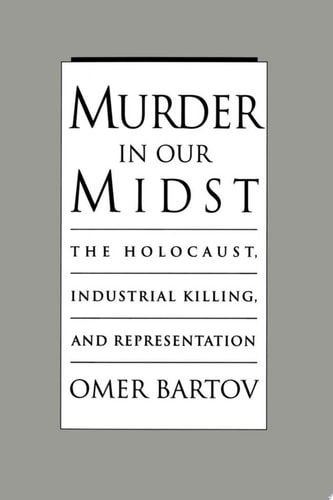
Murder in Our Midst: The Holocaust, Industrial Killing, and Representation
0
0
As an Amazon Associate and affiliate partner, Menrva Books earns from qualifying purchases. Learn more
Author Description
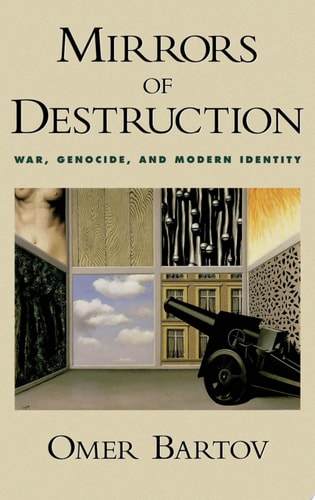
War endlessly tries to mask itself. The myth of the heroic soldier testing his individual courage stands in stark contrast to the reality of mass, anonymous death and the suppression of individual actions. Murder in Our Midst shows that this fundamental tension reached its natural conclusion in the Holocaust, and that disguising it has required an ongoing effort to misrepresent war and the Holocaust as something other than industrial killing. Examining a broad range of the representations of war's horrors, from scholarly depictions to those in popular literature, poetry, art, and the movies, Omer Bartov finds they have some things in common. Societies and cultures have attempted to form coherent images of horrific events, to draw didactic lessons from them, and to exploit them to legitimate ideological or political positions. Made up of interconnected essays, this book is both a scholarly and an often personal and passionate examination of the emergence, implementation, and representation of industrial killing. Bartov draws out the links between recent revisionist attempts to minimize and deny the Holocaust, and Hollywood's ongoing fascination with National Socialism and Hitler's "Final Solution." Arguing that the modern predicament reflects the effects of the Nazi genocide on current perceptions of war, history, and memory, this book is a plea for compassion and commitment in an increasingly violent and indifferent world.
Menrva's Summary
THE THESIS
This book investigates how the reality of industrial killing during the Holocaust has been systematically masked and misrepresented in cultural, political, and scholarly discourse. Omer Bartov, a prominent historian of Nazi Germany and the Holocaust, utilizes a multidisciplinary approach to analyze how societies attempt to sanitize or exploit mass violence. He argues that the modern perception of war is fundamentally shaped by the legacy of Nazi genocide and the ongoing tension between historical reality and the mythologizing of conflict.
THE SCOPE MAP
What You Will Find
- Analysis of the transition from individual combat to anonymous industrial killing.
- Examination of Holocaust representation in literature, film, art, and academic scholarship.
- Critique of revisionist attempts to minimize or deny the historical reality of the Final Solution.
- Discussion of the intersection between Hollywood media and historical memory.
Scope Limits
- The text does not provide a comprehensive chronological history of the Holocaust itself.
- It does not focus on military strategy or tactical battlefield operations.
THE AUTHORITY PERSPECTIVE
Scholars and historians frequently cite this work for its incisive critique of how cultural memory is constructed and manipulated. Readers often note the academic density of the prose, which demands a high level of engagement with the philosophical and historical arguments presented.
Page Count:
250
Publication Date:
1996-01-01
Publisher:
Oxford University Press
ISBN-10:
019028272X
ISBN-13:
9780190282721
History
Jewish History
Military History
European History
Genocide
Community Tags
Similar Books