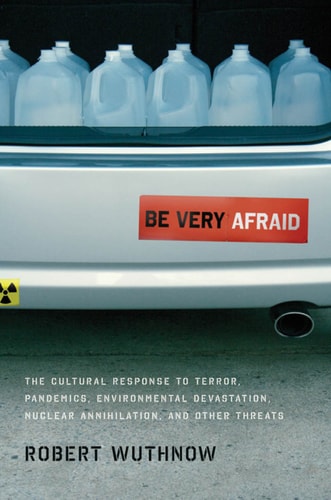
Be Very Afraid: The Cultural Response to Terror, Pandemics, Environmental Devastation, Nuclear Annihilation, and Other Threats
0
0
As an Amazon Associate and affiliate partner, Menrva Books earns from qualifying purchases. Learn more
Author Description
Robert Wuthnow has been praised as one of "the country's best social scientists" by columnist David Brooks, who hails his writing as "tremendously valuable." The New York Times calls him "temperate, balanced, compassionate," adding, "one can't but admire Mr. Wuthnow's views." A leading authority on religion, he now addresses one of the most profound subjects: the end of the world.In Be Very Afraid, Wuthnow examines the human response to existential threats--once a matter for theology, but now looming before us in multiple forms. Nuclear weapons, pandemics, global warming: each threatens to destroy the planet, or at least to annihilate our species. Freud, he notes, famously taught that the standard psychological response to an overwhelming danger is denial. In fact, Wuthnow writes, the opposite is true: we seek ways of positively meeting the threat, of doing something--anything--even if it's wasteful and time-consuming. The atomic era that began with the bombing of Hiroshima sparked a flurry of activity, ranging from duck-and-cover drills, basement bomb shelters, and marches for a nuclear freeze. All were arguably ineffectual, yet each sprang from an innate desire to take action. It would be one thing if our responses were merely pointless, Wuthnow observes, but they can actually be harmful. Both the public and policymakers tend to model reactions to grave threats on how we met previous ones. The response to the terrorist attacks of 9/11, for example, echoed the Cold War--citizens went out to buy duct tape, mimicking 1950s-era civil defense measures, and the administration launched two costly conflicts overseas. Offering insight into our responses to everything from An Inconvenient Truth to the bird and swine flu epidemics, Robert Wuthnow provides a profound new understanding of the human reaction to existential vulnerability.
Menrva's Summary
THE THESIS
This book investigates the psychological and social mechanisms that drive human behavior when faced with existential threats, challenging the common assumption that denial is our primary response. Robert Wuthnow, a prominent social scientist, utilizes historical data and sociological analysis to argue that humans possess an innate, often counterproductive, drive to take tangible action in the face of overwhelming danger. He examines how past responses to crises, such as the Cold War, shape contemporary reactions to modern threats like pandemics and climate change, often leading to policy decisions that are more performative than effective.
THE SCOPE MAP
What You Will Find
- Historical analysis of Cold War civil defense measures and their influence on modern policy.
- Sociological framework for understanding collective reactions to existential risks.
- Case studies ranging from the atomic era to the 9/11 terrorist attacks and global health epidemics.
- Examination of the psychological impulse to prioritize visible action over strategic efficacy.
THE AUTHORITY PERSPECTIVE
Experts recognize this work as a significant contribution to the sociology of risk and collective behavior. Readers frequently note the clarity of Wuthnow's prose, which makes complex sociological concepts accessible to a general audience while maintaining academic rigor.
Page Count:
304
Publication Date:
2010-01-01
Publisher:
Oxford University Press
ISBN-10:
0199889740
ISBN-13:
9780199889747
Non-Fiction
Psychology
Religion
Epidemics
Fear
Terrorism
Sociology
Global warming
Extortion
Nuclear weapons
Community Tags
Similar Books