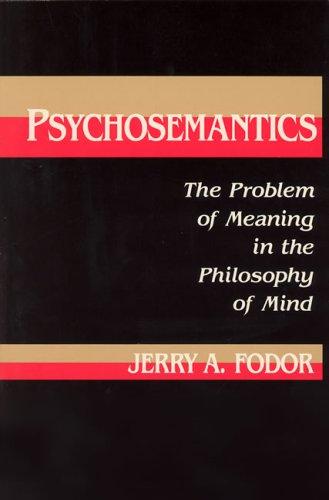
Psychosemantics
0
0
As an Amazon Associate and affiliate partner, Menrva Books earns from qualifying purchases. Learn more
Author Description
Jerry A. Fodor's Psychosemantics is a seminal work in the philosophy of mind and language. Fodor, a leading figure in cognitive science, presents his influential theory of mental content, arguing that mental states have meaning in virtue of their causal relations to the external world. He defends a representational theory of mind, proposing that thoughts are composed of symbols that refer to things in the world. The book critically examines alternative theories, particularly holistic approaches to meaning, and lays out the foundations for a scientific understanding of how minds work. Psychosemantics remains a cornerstone text for anyone interested in the relationship between thought, language, and reality.
Menrva's Summary
THE THESIS
The central question of Psychosemantics is whether mental content can be understood through a theory of meaning. Fodor, a prominent philosopher of mind, explores the relationship between thought and language, proposing that the meaning of mental states is determined by their causal relations to the external world. He argues against holistic theories of meaning and develops a representational theory of mind, suggesting that mental states are composed of symbols with specific contents. The book grapples with the implications of this theory for understanding how minds work and how language functions.
THE SCOPE MAP
- A detailed examination of the theory of meaning and its connection to mental content.
- Fodor's representational theory of mind and its foundational principles.
- Critiques of holistic theories of meaning and their limitations.
- Exploration of the causal theory of reference as applied to mental states.
- Discussion of the compositionality of mental representations.
- Analysis of the implications for cognitive science and philosophy of language.
THE AUTHORITY PERSPECTIVE
Psychosemantics is recognized as a significant contribution to the philosophy of mind and language, particularly for its defense of a representational theory of mind. Scholars often cite Fodor's rigorous argumentation and his clear articulation of complex ideas. The book is considered essential reading for those studying semantics, cognitive science, and the nature of thought, offering a foundational text for understanding how meaning is constituted in the mind.
Page Count:
187
Publication Date:
1989-01-01
ISBN-10:
0262560526
ISBN-13:
9780262560528
Psychology
Philosophy
Non-Fiction
Linguistics
Community Tags
Similar Books