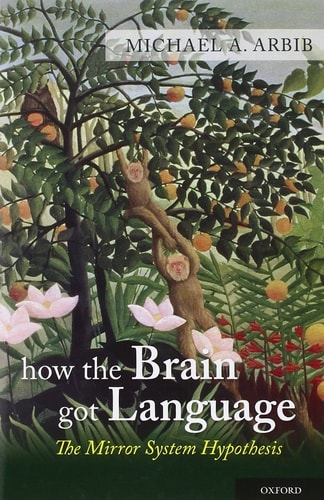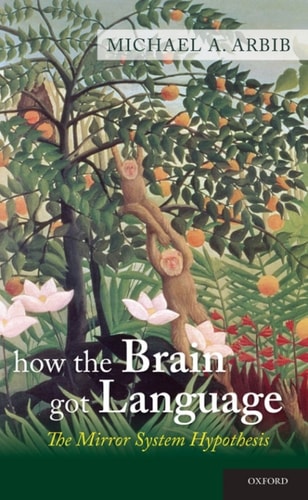
How the Brain Got Language: The Mirror System Hypothesis
0
0
As an Amazon Associate and affiliate partner, Menrva Books earns from qualifying purchases. Learn more
Author Description
Unlike any other species, humans can learn and use language. This book explains how the brain evolved to make language possible, through what Michael Arbib calls the Mirror System Hypothesis. Because of mirror neurons, monkeys, chimps, and humans can learn by imitation, but only "complex imitation," which humans exhibit, is powerful enough to support the breakthrough to language. This theory provides a path from the openness of manual gesture, which we share with nonhuman primates, through the complex imitation of manual skills, pantomime, protosign (communication based on conventionalized manual gestures), and finally to protospeech. The theory explains why we humans are as capable of learning sign languages as we are of learning to speak. This fascinating book shows how cultural evolution took over from biological evolution for the transition from protolanguage to fully fledged languages. The author explains how the brain mechanisms that made the original emergence of languages possible, perhaps 100,000 years ago, are still operative today in the way children acquire language, in the way that new sign languages have emerged in recent decades, and in the historical processes of language change on a time scale from decades to centuries. Though the subject is complex, this book is highly readable, providing all the necessary background in primatology, neuroscience, and linguistics to make the book accessible to a general audience.
Menrva's Summary
THE THESIS
This book investigates the biological and cognitive mechanisms that enabled the evolution of human language from non-human primate precursors. Michael A. Arbib, a prominent neuroscientist, synthesizes data from primatology, neuroscience, and linguistics to propose the Mirror System Hypothesis. He argues that the capacity for complex imitation, rooted in the mirror neuron system, provided the necessary foundation for the transition from manual gesture to fully developed speech.
THE SCOPE MAP
What You Will Find
- The Mirror System Hypothesis as a framework for language evolution
- Analysis of the transition from manual gesture to protosign and protospeech
- Comparative studies of primate imitation versus human complex imitation
- Examination of how cultural evolution supplements biological evolution in language acquisition
THE AUTHORITY PERSPECTIVE
Experts recognize this work as a significant contribution to the study of language origins, noting its interdisciplinary approach to complex neurobiological questions. Readers frequently highlight the author's ability to synthesize dense technical material into a coherent narrative that remains accessible to those outside the immediate field.
Page Count:
432
Publication Date:
2012-01-01
Publisher:
Oxford University Press
ISBN-10:
0199896690
ISBN-13:
9780199896691
Science
Evolutionary Biology
Neuroscience
Linguistics
Primatology