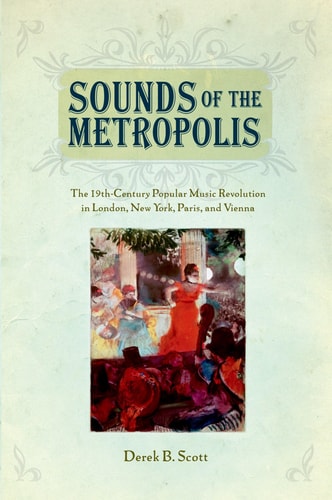
Sounds of the Metropolis: The 19th Century Popular Music Revolution in London, New York, Paris and Vienna
0
0
As an Amazon Associate and affiliate partner, Menrva Books earns from qualifying purchases. Learn more
Author Description
The phrase "popular music revolution" may instantly bring to mind such twentieth-century musical movements as jazz and rock 'n' roll. In Sounds of the Metropolis, however, Derek Scott argues that the first popular music revolution actually occurred in the nineteenth century, illustrating how a distinct group of popular styles first began to assert their independence and values. He explains the popular music revolution as driven by social changes and the incorporation of music into a system of capitalist enterprise, which ultimately resulted in a polarization between musical entertainment (or "commercial" music) and "serious" art. He focuses on the key genres and styles that precipitated musical change at that time, and that continued to have an impact upon popular music in the next century. By the end of the nineteenth century, popular music could no longer be viewed as watered down or more easily assimilated art music; it had its own characteristic techniques, forms, and devices. As Scott shows, "popular" refers here, for the first time, not only to the music's reception, but also to the presence of these specific features of style. The shift in meaning of "popular" provided critics with tools to condemn music that bore the signs of the popular-which they regarded as fashionable and facile, rather than progressive and serious. A fresh and persuasive consideration of the genesis of popular music on its own terms, Sounds of the Metropolis breaks new ground in the study of music, cultural sociology, and history.
Menrva's Summary
THE THESIS
Derek B. Scott investigates the emergence of a distinct popular music revolution during the nineteenth century, challenging the assumption that such movements began only in the twentieth century. Scott, a professor of music, utilizes historical analysis and cultural sociology to argue that the commercialization of music and shifting social structures created a divide between popular entertainment and serious art. He posits that popular music developed its own unique formal techniques and stylistic devices, moving beyond a mere derivative of classical art music.
THE SCOPE MAP
What You Will Find
- Comparative analysis of musical developments in London, New York, Paris, and Vienna.
- Examination of the capitalist enterprise systems that integrated music into the marketplace.
- Historical evidence tracing the evolution of musical forms and stylistic devices.
- Discussion on the shifting critical definitions of 'popular' versus 'serious' art.
THE AUTHORITY PERSPECTIVE
Scholars and music historians recognize this work as a significant contribution to the study of nineteenth-century cultural shifts. Readers frequently note the academic rigor and the clarity with which Scott delineates the transition from art music to commercialized popular forms.
Page Count:
314
Publication Date:
2011-12-01
Publisher:
Oxford University Press
ISBN-10:
0199891877
ISBN-13:
9780199891870
Sociology
Humanities
Music american
Cultural History
Music European
Music History
Popular music
19th Century
Community Tags
Similar Books