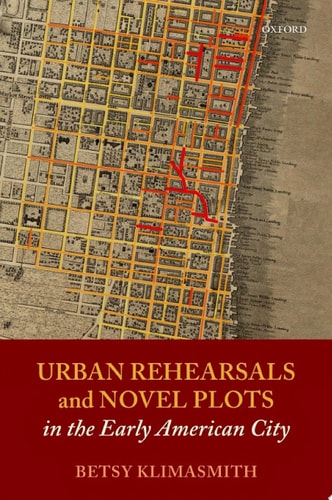
Urban Rehearsals and Novel Plots in the Early American City
0
0
As an Amazon Associate and affiliate partner, Menrva Books earns from qualifying purchases. Learn more
Author Description
Urban Rehearsals and Novel Plots in the Early American City sheds new light on the literature of the early US by exploring how literature, theatre, architecture, and images worked together to allow readers to imagine themselves as urbanites even before cities developed. In the four decades following the Revolutionary War, the new nation was a loose network of nascent cities connected by print. Before a national culture could develop, local city cultures took shape; literary texts played key roles in helping new Americans become city people. Drawing on extensive archival research, Urban Rehearsals argues that literature, particularly novels and plays, allowed Bostonians to navigate the transition from colonial town to post-revolution city, enabled Philadelphians to grieve their experiences of the 1793 Yellow Fever epidemic and rebuild in the epidemic's aftermath, and showed New Yorkers how the domestic practices that reinforced their urbanity could be opened to the broader public. Throughout, attention to underrepresented voices and texts calls attention to the possibilities for women, immigrants, and Black Americans in developing urban spaces, while showing how those possibilities would be foreclosed as the nation developed. Balancing attention to canonical texts of the early Republic, including The Power of Sympathy, Charlotte Temple, and Benjamin Franklin's Autobiography, with novels whose depiction of early cities deserves greater attention, such as Ormond, The Boarding-School, Monima, and Kelroy, this volume shows how US cities developed on the pages and stages of the early Republic, building urban imaginations that would construct the nation's early cities.
Menrva's Summary
THE THESIS
This book investigates how early American literature, theatre, and architecture functioned as a collaborative framework for citizens to construct an urban identity before physical cities were fully established. Author Betsy Klimasmith, a scholar of American literature and urban culture, utilizes extensive archival research to demonstrate that novels and plays served as training grounds for the social behaviors and civic expectations required in the post-Revolutionary era. By examining the intersection of print culture and urban development, the text argues that the literary imagination was a primary engine for defining the American city.
THE SCOPE MAP
What You Will Find
- Analysis of canonical texts including The Power of Sympathy, Charlotte Temple, and Benjamin Franklin's Autobiography
- Examination of lesser-known works such as Ormond, The Boarding-School, Monima, and Kelroy
- Historical investigation into the 1793 Philadelphia Yellow Fever epidemic and its impact on urban narrative
- Exploration of the roles of women, immigrants, and Black Americans in early urban spaces
Scope Limits
- The study is geographically limited to the early urban centers of Boston, Philadelphia, and New York
- The analysis focuses primarily on the four decades following the Revolutionary War
THE AUTHORITY PERSPECTIVE
Scholars and critics recognize this work as a significant contribution to the study of early American print culture and its relationship to spatial development. Readers frequently note the meticulous archival research and the author's ability to bridge the gap between literary analysis and urban history.
Page Count:
275
Publication Date:
2021-01-01
Publisher:
OUP Oxford
ISBN-10:
0192661353
ISBN-13:
9780192661357
History
Indigenous
19th Century
American History
Urban Studies
Literary Criticism
Cultural History
Early American
Community Tags
Similar Books