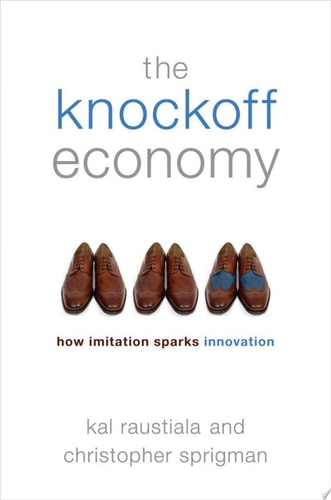
The Knockoff Economy: How Imitation Sparks Innovation
0
0
As an Amazon Associate and affiliate partner, Menrva Books earns from qualifying purchases. Learn more
Author Description
From The Shopping Mall To The Corner Bistro, Knockoffs Are Everywhere In Today's Marketplace. Conventional Wisdom Holds That Copying Kills Creativity, And That Laws That Protect Against Copies Are Essential To Innovation--and Economic Success. But Are Copyrights And Patents Always Necessary? In The Knockoff Economy, Kal Raustiala And Christopher Sprigman Provocatively Argue That Creativity Can Not Only Survive In The Face Of Copying, But Can Thrive. The Knockoff Economy Approaches The Question Of Incentives And Innovation In A Wholly New Way--by Exploring Creative Fields Where Copying Is Generally Legal, Such As Fashion, Food, And Even Professional Football. By Uncovering These Important But Rarely Studied Industries, Raustiala And Sprigman Reveal A Nuanced And Fascinating Relationship Between Imitation And Innovation. In Some Creative Fields, Copying Is Kept In Check Through Informal Industry Norms Enforced By Private Sanctions. In Others, The Freedom To Copy Actually Promotes Creativity. High Fashion Gave Rise To The Very Term Knockoff, Yet The Freedom To Imitate Great Designs Only Makes The Fashion Cycle Run Faster--and Forces The Fashion Industry To Be Even More Creative. Raustiala And Sprigman Carry Their Analysis From Food To Font Design To Football Plays To Finance, Examining How And Why Each Of These Vibrant Industries Remains Innovative Even When Imitation Is Common. There Is An Important Thread That Ties All These Instances Together--successful Creative Industries Can Evolve To The Point Where They Become Inoculated Against--and Even Profit From--a World Of Free And Easy Copying. And There Are Important Lessons Here For Copyright-focused Industries, Like Music And Film, That Have Struggled As Digital Technologies Have Made Copying Increasingly Widespread And Difficult To Stop. Raustiala And Sprigman's Arguments Have Been Making Headlines In The New Yorker, The New York Times, The Financial Times, The Boston Globe, Le Monde, And At The Freakonomics Blog, Wh
Menrva's Summary
THE THESIS
Does the widespread practice of imitation necessarily stifle innovation, or can it serve as a catalyst for creative growth? Authors Kal Raustiala and Christopher Sprigman, both legal scholars, examine industries where intellectual property protections are weak or non-existent to challenge the conventional belief that strict copyright and patent enforcement is the only path to economic success. By analyzing diverse sectors, they argue that copying often forces creators to innovate faster and more effectively to maintain their competitive edge.
THE SCOPE MAP
What You Will Find
- Analysis of industries with minimal intellectual property protection, including fashion, food, and professional sports.
- Examination of informal industry norms and private sanctions used to regulate imitation.
- Case studies demonstrating how the freedom to copy accelerates product cycles and design evolution.
- Comparative insights for digital-era industries like film and music struggling with widespread piracy.
THE AUTHORITY PERSPECTIVE
Experts and reviewers frequently cite this work as a provocative challenge to standard intellectual property theory, noting its accessible prose and wide-ranging examples. It is widely regarded as a foundational text for understanding how creative markets function in the absence of traditional legal barriers.
Page Count:
280
Publication Date:
2012-01-01
Publisher:
Oxford University Press, Incorporated
ISBN-10:
0199908524
ISBN-13:
9780199908523
Business
Economics
Intellectual Property
Pirated editions
Business Ethics
Sociology
Innovation
Sound recordings
Copyright
Copyright music
Community Tags
Other Editions(2)
Similar Books







Reader Comments
Share Your Thoughts
No comments yet. Be the first to share your thoughts!