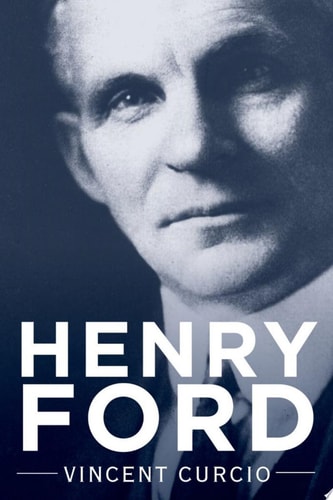
Henry Ford
0
0
As an Amazon Associate and affiliate partner, Menrva Books earns from qualifying purchases. Learn more
Author Description
Most great figures in American history reveal great contradictions, and Henry Ford is no exception. He championed his workers, offering unprecedented wages, yet crushed their attempts to organize. Virulently anti-Semitic, he never employed fewer than 3,000 Jews. An outspoken pacifist, he made millions producing war materials. He urbanized the modern world, and then tried to drag it back into a romanticized rural past he'd helped to destroy. As the American auto industry struggles to reinvent itself, Vincent Curcio's timely biography offers a wealth of new insight into the man who started it all. Henry Ford not only founded Ford Motor Company but institutionalized assembly line production and, some would argue, created the American middle class. By constantly improving his product and increasing sales, Ford was able to lower the price of the automobile until it became a universal commodity. He paid his workers so well that, for the first time in history, the people who manufactured a complex industrial product could own one. This was "Fordism"--social engineering on a vast scale. But, as Curcio displays, Ford's anti-Semitism would forever stain his reputation. Hitler admired him greatly, both for his anti-Semitism and his autocratic leadership, displaying Ford's picture in his bedroom and keeping a copy of Ford's My Life and Work by his bedside. Nevertheless, Ford's economic and social initiatives, as well as his deft handling of his public image, kept his popularity high among Americans. He offered good pay, good benefits, English language classes, and employment for those who struggled to find jobs--handicapped, African-American, and female workers. Such was his popularity that in 1923, the homespun, clean-living, xenophobic Henry Ford nearly won the Republican presidential nomination.This new volume in the Lives and Legacies series explores the full impact of Ford's indisputable greatness, the deep flaws that complicate his legacy, and what he means for our own ti
Menrva's Summary
THE THESIS
This biography investigates the profound contradictions of Henry Ford, examining how his industrial innovations simultaneously built the American middle class and revealed deep personal and moral failings. Vincent Curcio utilizes historical records and archival research to analyze Ford's complex legacy, from the implementation of assembly line production and the concept of 'Fordism' to his well-documented anti-Semitism and autocratic management style. The text argues that Ford's influence on the modern world is inseparable from the ideological conflicts that defined his life and public image.
THE SCOPE MAP
What You Will Find
- Analysis of the development and implementation of assembly line production techniques.
- Examination of Ford's labor policies, including the five-dollar day and social engineering initiatives.
- Historical context regarding Ford's political aspirations and his impact on the American middle class.
- Critical review of Ford's personal prejudices, including his anti-Semitism and its influence on contemporary figures.
THE AUTHORITY PERSPECTIVE
Experts and readers recognize this work as a balanced, comprehensive examination of a polarizing historical figure. The text is frequently cited for its ability to reconcile Ford's immense economic contributions with his significant personal flaws.
Page Count:
334
Publication Date:
2013-01-01
Publisher:
Oxford University Press
ISBN-10:
0199911207
ISBN-13:
9780199911202
History
Biography
Business
American History
Ford Motor Company
English & College Success
Industrial history
English
Biography Autobiography
Community Tags
Other Editions(4)


Similar Books






Reader Comments
Share Your Thoughts
No comments yet. Be the first to share your thoughts!