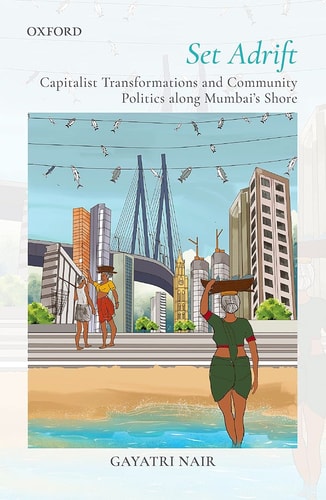
Set Adrift: Capitalist Transformations and Community Politics along Mumbai's Shores
0
0
As an Amazon Associate and affiliate partner, Menrva Books earns from qualifying purchases. Learn more
Author Description
The Koli community in Mumbai-which has been practising fishing for centuries-has experienced rapid changes over the last few decades, in the forms of increased mechanization, export of fish to global markets, and the pressure of urbanization on their living and work spaces. The capitalist transformation in fishing has altered what was once a caste-based practice to one that brought to it investors from outside the community, migrant workers, and ecological degradation. The resultant loss of revenue, jobs, and catch for artisanal fishers has led to movements demanding fishing rights to be granted to traditional fisher communities alone and for a return to older fishing practices. This call found resonance with populist politics in the city: Koli women organized themselves to stridently resist the entry of migrant men into the sector and Koli men-particularly the young-became inclined to move out of the practice of fishing.Through an examination of the lives and struggles of fishers in one of India's wealthiest cities, this book looks at how contestations around livelihoods map out in the shadow of significant encounters between capitalism and ecology.
Menrva's Summary
THE THESIS
How does the intersection of capitalist expansion and ecological degradation reshape the livelihoods and political agency of traditional fishing communities in Mumbai? Gayatri Nair, an Assistant Professor of Sociology, utilizes ethnographic research to examine the Koli community's transition from traditional, caste-based fishing to a modernized, market-driven industry. The book argues that these economic shifts have triggered complex social tensions, including labor migration, gendered resistance, and the emergence of populist political movements centered on resource rights.
THE SCOPE MAP
What You Will Find
- Analysis of the mechanization and globalization of the Mumbai fishing industry
- Examination of the role of Koli women in resisting labor shifts
- Study of the impact of urban development on coastal work spaces
- Investigation into the intersection of caste, ecology, and capital
Scope Limits
- The study focuses specifically on the Koli community in Mumbai and does not provide a comprehensive analysis of all Indian coastal fishing regions
- The text prioritizes sociological and political analysis over technical marine biology or economic forecasting
THE AUTHORITY PERSPECTIVE
Scholars in urban sociology and political economy identify this work as a significant contribution to the study of marginalized communities within rapidly developing global cities. Readers frequently note the academic rigor of the prose and the clarity with which the author connects local struggles to broader capitalist frameworks.
Page Count:
220
Publication Date:
2021-01-01
Publisher:
Oxford University Press
ISBN-10:
0190130245
ISBN-13:
9780190130244
Urban Studies
Labor Studies
Sociology
India
Community Tags
Similar Books