Taking Sudoku Seriously: The Math Behind the World's Most Popular Pencil Puzzle
0
0
As an Amazon Associate and affiliate partner, Menrva Books earns from qualifying purchases. Learn more
Author Description
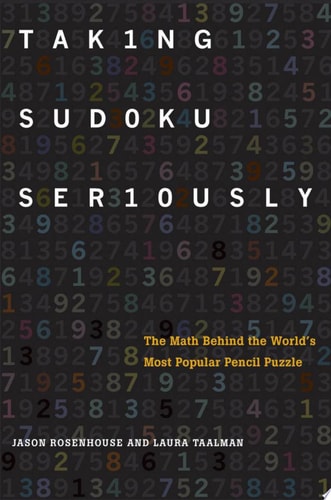
Packed with more than a hundred color illustrations and a wide variety of puzzles and brainteasers, Taking Sudoku Seriously uses this popular craze as the starting point for a fun-filled introduction to higher mathematics. How many Sudoku solution squares are there? What shapes other than three-by-three blocks can serve as acceptable Sudoku regions? What is the fewest number of starting clues a sound Sudoku puzzle can have? Does solving Sudoku require mathematics? Jason Rosenhouse and Laura Taalman show that answering these questions opens the door to a wealth of interesting mathematics. Indeed, they show that Sudoku puzzles and their variants are a gateway into mathematical thinking generally. Among many topics, the authors look at the notion of a Latin square--an object of long-standing interest to mathematicians--of which Sudoku squares are a special case; discuss how one finds interesting Sudoku puzzles; explore the connections between Sudoku, graph theory, and polynomials; and consider Sudoku extremes, including puzzles with the maximal number of vacant regions, with the minimal number of starting clues, and numerous others. The book concludes with a gallery of novel Sudoku variations--just pure solving fun! Most of the puzzles are original to this volume, and all solutions to the puzzles appear in the back of the book or in the text itself. A math book and a puzzle book, Taking Sudoku Seriously will change the way readers look at Sudoku and mathematics, serving both as an introduction to mathematics for puzzle fans and as an exploration of the intricacies of Sudoku for mathematics buffs.
Menrva's Summary
THE THESIS
How can the popular puzzle of Sudoku serve as a rigorous entry point into the principles of higher mathematics? Jason Rosenhouse and Laura Taalman, both experienced mathematicians, utilize the logic of Sudoku to introduce readers to complex concepts such as graph theory, combinatorics, and Latin squares. By dissecting the structural requirements of a valid puzzle, the authors demonstrate that the skills required for solving Sudoku are fundamentally mathematical in nature. The text bridges the gap between casual recreational puzzle-solving and formal mathematical inquiry.
THE SCOPE MAP
What You Will Find
- Mathematical analysis of Latin squares and their relationship to Sudoku grids.
- Explorations of graph theory, polynomials, and combinatorial constraints.
- Investigations into puzzle extremes, including minimal clue counts and maximal vacant regions.
- A collection of original Sudoku variants and brainteasers designed to test logical reasoning.
THE AUTHORITY PERSPECTIVE
Experts and educators frequently cite this work as a bridge between recreational mathematics and formal academic study. Readers note that the text remains accessible to puzzle enthusiasts while providing enough technical depth to satisfy those interested in the underlying mathematical theory.
Page Count:
226
Publication Date:
2012-01-01
Publisher:
Oxford University Press
ISBN-10:
0199913153
ISBN-13:
9780199913152
Non-Fiction
Games
Mathematics Statistics
Mathematics
Sudoku
Post-Calculus
Puzzles
Community Tags
Similar Books