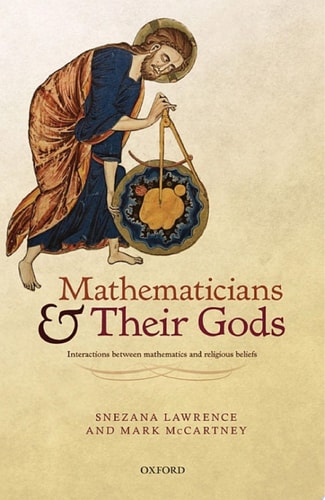
Mathematicians and Their Gods: Interactions Between Mathematics and Religious Beliefs
0
0
As an Amazon Associate and affiliate partner, Menrva Books earns from qualifying purchases. Learn more
Author Description
To open a newspaper or turn on the television it would appear that science and religion are polar opposites - mutually exclusive bedfellows competing for hearts and minds. There is little indication of the rich interaction between religion and science throughout history, much of which continues today. From ancient to modern times, mathematicians have played a key role in this interaction. This is a book on the relationship between mathematics and religious beliefs. It aims to show that, throughout scientific history, mathematics has been used to make sense of the 'big' questions of life, and that religious beliefs sometimes drove mathematicians to mathematics to help them make sense of the world. Containing contributions from a wide array of scholars in the fields of philosophy, history of science and history of mathematics, this book shows that the intersection between mathematics and theism is rich in both culture and character. Chapters cover a fascinating range of topics including the Sect of the Pythagoreans, Newton's views on the apocalypse, Charles Dodgson's Anglican faith and Gödel's proof of the existence of God.
Menrva's Summary
THE THESIS
This book investigates the historical and intellectual intersection between mathematical inquiry and religious belief systems. Authors Mark McCartney and Snezana Lawrence curate a collection of essays from scholars in philosophy and the history of science to demonstrate that mathematics has frequently served as a framework for addressing existential questions. The text argues that religious conviction has historically acted as a primary motivator for mathematical discovery rather than a deterrent.
THE SCOPE MAP
What You Will Find
- Historical analysis of the Pythagorean sect and their mystical mathematical practices
- Examination of Isaac Newton's theological writings regarding the apocalypse
- Case studies on figures such as Charles Dodgson and Kurt Gödel
- Interdisciplinary perspectives from historians and philosophers
Scope Limits
- The text does not provide a comprehensive survey of all world religions
- It does not attempt to prove or disprove the existence of God through mathematical logic
THE AUTHORITY PERSPECTIVE
Experts identify this work as a valuable resource for those interested in the intersection of intellectual history and theology. Readers frequently note the accessible yet scholarly nature of the essays, which provide a nuanced look at how faith has influenced scientific development.
Page Count:
320
Publication Date:
2015-01-01
Publisher:
OUP Oxford
ISBN-10:
0191007552
ISBN-13:
9780191007552
Biography
Non-Fiction
Mathematics
Science History
Philosophy of
Mathematics - General
Mathematics Statistics
Community Tags
Similar Books