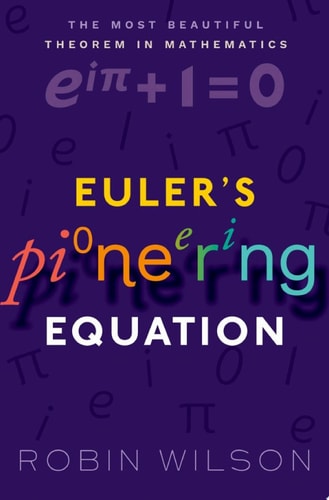
Euler's Pioneering Equation: The Most Beautiful Theorem in Mathematics
0
0
As an Amazon Associate and affiliate partner, Menrva Books earns from qualifying purchases. Learn more
Author Description
In 1988 The Mathematical Intelligencer, a quarterly mathematics journal, carried out a poll to find the most beautiful theorem in mathematics. Twenty-four theorems were listed and readers were invited to award each a 'score for beauty'. While there were many worthy competitors, the winner was 'Euler's equation'. In 2004 Physics World carried out a similar poll of 'greatest equations', and found that among physicists Euler's mathematical result came second only to Maxwell's equations. The Stanford mathematician Keith Devlin reflected the feelings of many in describing it as "like a Shakespearian sonnet that captures the very essence of love, or a painting which brings out the beauty of the human form that is far more than just skin deep, Euler's equation reaches down into the very depths of existence". What is it that makes Euler's identity, eiπ + 1 = 0, so special? In Euler's Pioneering Equation Robin Wilson shows how this simple, elegant, and profound formula links together perhaps the five most important numbers in mathematics, each associated with a story in themselves: the number 1, the basis of our counting system; the concept of zero, which was a major development in mathematics, and opened up the idea of negative numbers; π an irrational number, the basis for the measurement of circles; the exponential e, associated with exponential growth and logarithms; and the imaginary number i, the square root of -1, the basis of complex numbers. Following a chapter on each of the elements, Robin Wilson discusses how the startling relationship between them was established, including the several near misses to the discovery of the formula.
Menrva's Summary
THE THESIS
This book investigates the mathematical significance and historical context of Euler's identity, eiπ + 1 = 0, to explain why it is widely regarded as the most beautiful theorem in mathematics. Robin Wilson, a noted mathematician and historian, utilizes a biographical and analytical framework to deconstruct the five fundamental constants contained within the equation. By tracing the development of each number, the author provides a clear narrative on how these disparate concepts were eventually synthesized into a single, elegant formula.
THE SCOPE MAP
What You Will Find
- Historical analysis of the numbers 1, 0, π, e, and i
- Chronological account of the mathematical discoveries leading to the identity
- Biographical sketches of the mathematicians involved in the evolution of these concepts
- Discussion of near-miss discoveries and the eventual formalization of the equation
Scope Limits
- The text does not provide an exhaustive textbook-style proof for every advanced application of complex analysis
- It focuses primarily on the history and conceptual beauty of the identity rather than purely technical problem-solving exercises
THE AUTHORITY PERSPECTIVE
Experts and readers alike appreciate this work for its accessible approach to high-level mathematical history. The text is frequently cited as a clear, engaging resource for those interested in the human stories behind abstract mathematical constants.
Page Count:
170
Publication Date:
2018-01-01
Publisher:
OUP Oxford
ISBN-10:
0192514067
ISBN-13:
9780192514066
Non-Fiction
Science
Biography
Mathematics - General
Mathematics
Mathematics Statistics
Eulers Numbers
Science History
Community Tags
Similar Books