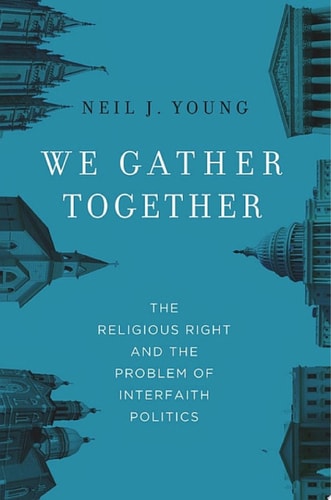
We Gather Together: The Religious Right and the Problem of Interfaith Politics
0
0
As an Amazon Associate and affiliate partner, Menrva Books earns from qualifying purchases. Learn more
Author Description
The story of the birth of the Religious Right is a familiar one. In the 1970s, mainly in response to Roe v. Wade, evangelicals and conservative Catholics put aside their longstanding historical prejudices and theological differences and joined forces to form a potent political movement that swept across the country. In this provocative book, Neil J. Young argues that almost none of this is true. Young offers an alternative history of the Religious Right that upends these widely-believed myths.Theology, not politics, defined the Religious Right. The rise of secularism, pluralism, and cultural relativism, Young argues, transformed the relations of America's religious denominations. The interfaith collaborations among liberal Protestants, Catholics, and Jews were met by a conservative Christian counter-force, which came together in a loosely bound, politically-minded coalition known as the Religious Right. This right-wing religious movement was made up of Mormons, conservative Catholics, and evangelicals, all of whom were united--paradoxically--by their contempt for the ecumenical approach they saw the liberal denominations taking. Led by the likes of Jerry Falwell, they deemed themselves the "pro-family" movement, and entered full-throated into political debates about abortion, school prayer, the Equal Rights Amendment, gay rights, and tax exemptions for religious schools. They would go on to form a critical new base for the Republican Party. Examining the religious history of interfaith dialogue among conservative evangelicals, Catholics, and Mormons, Young argues that the formation of the Religious Right was not some brilliant political strategy hatched on the eve of a history-altering election but rather the latest iteration of a religious debate that had gone on for decades. This path breaking book will reshape our understanding of the most important religious and political movement of the last 30 years.
Menrva's Summary
THE THESIS
This book investigates the origins of the American Religious Right, challenging the conventional narrative that it emerged primarily as a political reaction to the 1973 Roe v. Wade decision. Neil J. Young, a historian of American religion and politics, utilizes archival research and historical analysis to argue that the movement was rooted in long-standing theological debates regarding secularism and pluralism. He posits that the coalition of evangelicals, conservative Catholics, and Mormons was driven by a shared opposition to the ecumenical interfaith collaborations of liberal denominations rather than a singular, calculated political strategy.
THE SCOPE MAP
What You Will Find
- Historical analysis of the shifting relations between American religious denominations from the 1970s onward.
- Examination of the theological tensions between conservative religious groups and liberal ecumenical movements.
- Case studies on the political mobilization of the "pro-family" movement regarding issues like school prayer and the Equal Rights Amendment.
- An exploration of how religious identity and interfaith dialogue shaped the modern Republican Party base.
THE AUTHORITY PERSPECTIVE
Scholars and political historians frequently cite this work for its ability to reframe the narrative of the Religious Right by centering theology over political opportunism. Readers often note the academic rigor of the prose, which provides a nuanced look at the complex alliances formed between historically disparate religious groups.
Page Count:
432
Publication Date:
2015-01-01
Publisher:
Oxford University Press
ISBN-10:
0199911916
ISBN-13:
9780199911912
History
Religion
Politics
Jesus Christ
Sociology
American History
United States
Community Tags
Other Editions(2)
Similar Books















Reader Comments
Share Your Thoughts
No comments yet. Be the first to share your thoughts!