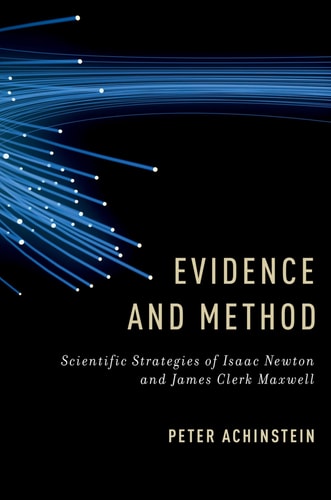
Evidence and Method: Scientific Strategies of Isaac Newton and James Clerk Maxwell
0
0
As an Amazon Associate and affiliate partner, Menrva Books earns from qualifying purchases. Learn more
Author Description
What is meant by scientific evidence, and how can a definition of this concept be applied in the sciences to determine whether observed facts constitute evidence that a given theory is true?In this book, Peter Achinstein proposes and defends several objective concepts of evidence. He then explores the question of whether a scientific method, such as that represented in the four "Rules for the Study of Natural Philosophy" that Isaac Newton invoked in proving his law of gravity, can be employed in demonstrating how the proposed definitions of evidence are to be applied to real scientific cases. In answering this question, he offers a new interpretation of Newton's controversial rules. Contrary to what many methodologists assume, whether the rules, so interpreted, can be used to determine whether observed phenomena provide evidence for a theory is an empirical question, not an a priori one. Finally, in order to deal with numerous cases in which evidence is insufficient to establish a theory, or where no theory is even available, Achinstein describes and defends three scientific methods proposed by the 19th century theoretical physicist James Clerk Maxwell, in the course of developing his electrical and molecular theories.
Menrva's Summary
THE THESIS
This book investigates the definition of scientific evidence and the methodologies used to determine if observed facts substantiate a given theory. Peter Achinstein, a philosopher of science, utilizes historical case studies from the work of Isaac Newton and James Clerk Maxwell to construct an objective framework for evaluating evidence. He argues that the validity of scientific methods is an empirical matter rather than an a priori assumption, challenging traditional methodological interpretations.
THE SCOPE MAP
What You Will Find
- A critical re-evaluation of Isaac Newton’s four Rules for the Study of Natural Philosophy.
- An analysis of James Clerk Maxwell’s methodologies in developing electrical and molecular theories.
- A proposed set of objective definitions for what constitutes scientific evidence.
- A discussion on handling scenarios where evidence is insufficient to establish a definitive theory.
THE AUTHORITY PERSPECTIVE
Scholars and philosophers of science recognize this work as a rigorous examination of the intersection between historical scientific practice and modern epistemology. Readers frequently note the academic density of the prose, which is intended for those with a background in the philosophy of science or the history of physics.
Page Count:
192
Publication Date:
2013-04-02
Publisher:
Oxford University Press
ISBN-10:
0199921857
ISBN-13:
9780199921850
Science
Philosophy
Epistemology
Empiricism
Physics
Science
Community Tags
Similar Books