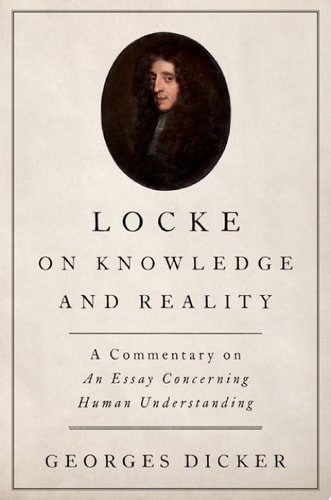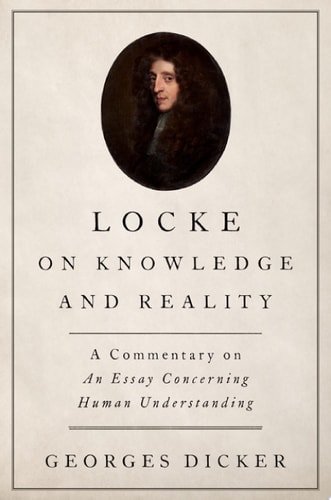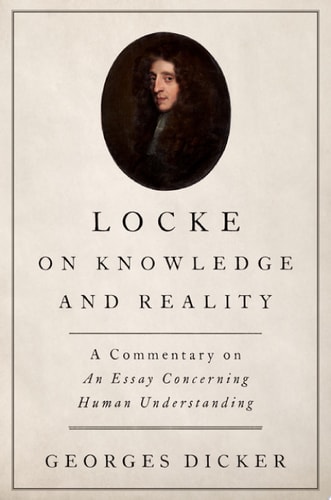
Locke on Knowledge and Reality: A Commentary on An Essay Concerning Human Understanding
0
0
As an Amazon Associate and affiliate partner, Menrva Books earns from qualifying purchases. Learn more
Author Description
Georges Dicker here provides a commentary on John Locke's masterwork, An Essay Concerning Human Understanding-the foundational work of classical Empiricism. Dicker's commentary is an accessible guide for students who are reading Locke for the first time; a useful research tool for upper-level undergraduate and graduate students; and a contribution to Locke scholarship for professional scholars. It is designed to be read alongside the Essay, but does not presuppose familiarity with it.Dicker expounds and critically discusses the main theses and arguments of each of the Essay's four books, on the innatism that Locke opposes, the origin and classification of ideas, language and meaning, and knowledge, respectively. He analyses Locke's influential explorations of related topics, including primary and secondary qualities, substance, identity, personal identity, free will, nominal and real essences, perception, and external-world skepticism, among others. Written in an analytical style that strives for clarity, the book offers careful textual analyses as well as step-by-step reconstructions of Locke's arguments, and it references and engages with relevant work of other major philosophers and Locke commentators.
Menrva's Summary
THE THESIS
This commentary investigates the core philosophical arguments and epistemological framework presented in John Locke's An Essay Concerning Human Understanding. Georges Dicker, a scholar of modern philosophy, provides a systematic reconstruction of Locke's foundational text. The work serves as both an instructional guide for students and a critical analysis for professional philosophers, utilizing a step-by-step examination of Locke's four books to clarify his positions on innatism, the origin of ideas, and the nature of knowledge.
THE SCOPE MAP
What You Will Find
- Detailed analysis of Locke's four books regarding innatism, ideas, language, and knowledge.
- Examination of key concepts including primary and secondary qualities, substance, and personal identity.
- Reconstructions of arguments concerning free will, nominal and real essences, and external-world skepticism.
Scope Limits
- The text focuses primarily on the arguments within the Essay and does not provide a comprehensive biography of Locke.
- It does not attempt to cover the entirety of 17th-century political philosophy, focusing instead on the epistemological and metaphysical content of the Essay.
THE AUTHORITY PERSPECTIVE
Scholars and students frequently cite this work for its analytical clarity and its ability to bridge the gap between introductory study and advanced research. Experts highlight the text as a reliable resource for navigating the complexities of classical Empiricism.
Page Count:
334
Publication Date:
2019-07-29
Publisher:
Oxford University Press
ISBN-10:
0190662190
ISBN-13:
9780190662196
Philosophy
Epistemology
Empiricism
Philosophy history
ESSAYS single author
Academic Commentary