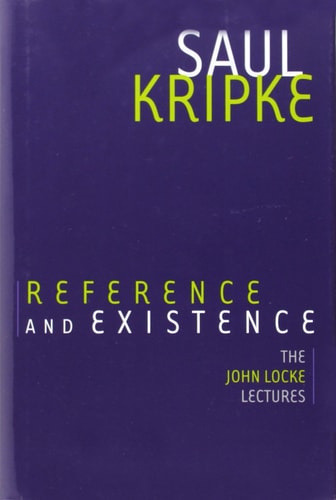
Reference and Existence: The John Locke Lectures
0
0
As an Amazon Associate and affiliate partner, Menrva Books earns from qualifying purchases. Learn more
Author Description
Reference and Existence, Saul Kripke's John Locke Lectures for 1973, can be read as a sequel to his classic Naming and Necessity. It confronts important issues left open in that work -- among them, the semantics of proper names and natural kind terms as they occur in fiction and in myth; negative existential statements; the ontology of fiction and myth (whether it is true that fictional characters like Hamlet, or mythical kinds like bandersnatches, might have existed). In treating these questions, he makes a number of methodological observations that go beyond the framework of his earlier book -- including the striking claim that fiction cannot provide a test for theories of reference and naming. In addition, these lectures provide a glimpse into the transition to the pragmatics of singular reference that dominated his influential paper, "Speaker's Reference and Semantic Reference" -- a paper that helped reorient linguistic and philosophical semantics. Some of the themes have been worked out in later writings by other philosophers -- many influenced by typescripts of the lectures in circulation -- but none have approached the careful, systematic treatment provided here. The virtuosity of Naming and Necessity -- the colloquial ease of the tone, the dazzling, on-the-spot formulations, the logical structure of the overall view gradually emerging over the course of the lectures -- is on display here as well.
Menrva's Summary
THE THESIS
This work investigates the semantic properties of proper names and natural kind terms within the context of fiction, myth, and negative existential statements. Saul Kripke, a preeminent philosopher of language, utilizes these 1973 John Locke Lectures to address unresolved questions from his earlier seminal work, Naming and Necessity. He presents a systematic framework for understanding how reference functions when applied to non-existent entities, ultimately arguing that fiction does not serve as a valid testing ground for theories of reference.
THE SCOPE MAP
What You Will Find
- Analysis of the semantics of proper names and natural kind terms in fictional and mythical contexts
- Examination of negative existential statements and their logical implications
- Methodological observations regarding the ontology of fictional characters and mythical entities
- Exploration of the transition toward the pragmatics of singular reference
THE AUTHORITY PERSPECTIVE
Experts recognize this text as a vital, systematic expansion of Kripke's earlier work on naming and necessity. Readers frequently note the high level of philosophical density and the conversational yet rigorous tone characteristic of Kripke's lecture style.
Page Count:
270
Publication Date:
2013-08-29
Publisher:
Oxford University Press
ISBN-10:
019992838X
ISBN-13:
9780199928385
Philosophy
Semantics
Ontology
Reference Philosophy
Logic
Linguistics
Metaphysics
Community Tags
Similar Books