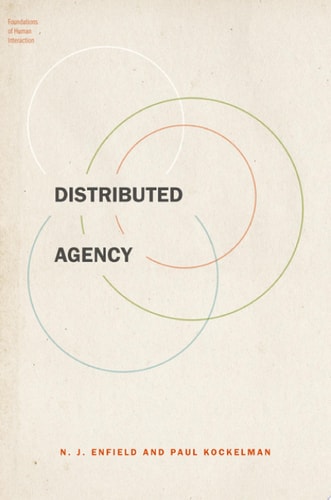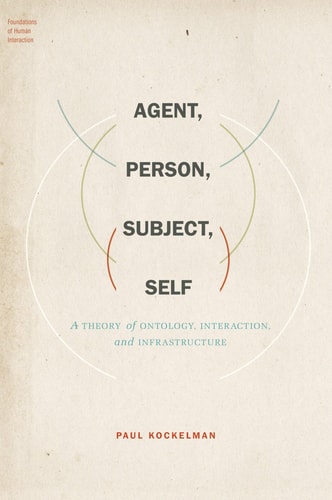
Agent, Person, Subject, Self: A Theory of Ontology, Interaction, and Infrastructure
0
0
As an Amazon Associate and affiliate partner, Menrva Books earns from qualifying purchases. Learn more
Author Description
This book offers both a naturalistic and critical theory of signs, minds, and meaning-in-the-world. It provides a reconstructive rather than deconstructive theory of the individual, one which both analytically separates and theoretically synthesizes a range of faculties that are often confused and conflated: agency (understood as a causal capacity), subjectivity (understood as a representational capacity), selfhood (understood as a reflexive capacity), and personhood (understood as a sociopolitical capacity attendant on being an agent, subject, or self). It argues that these facilities are best understood from a semiotic stance that supersedes the usual intentional stance. And, in so doing, it offers a pragmatism-grounded approach to meaning and mediation that is general enough to account for processes that are as embodied and embedded as they are articulated and enminded. In particular, while this theory is focused on human-specific modes of meaning, it also offers a general theory of meaning, such that the agents, subjects and selves in question need not always, or even usually, map onto persons. And while this theory foregrounds agents, persons, subjects and selves, it does this by theorizing processes that often remain in the background of such (often erroneously) individuated figures: ontologies (akin to culture, but generalized across agentive collectivities), interaction (not only between people, but also between people and things, and anything outside or in-between), and infrastructure (akin to context, but generalized to include mediation at any degree of remove).
Menrva's Summary
THE THESIS
This book investigates how the distinct faculties of agency, subjectivity, selfhood, and personhood can be synthesized into a coherent, naturalistic theory of meaning and interaction. Paul Kockelman, a scholar in linguistic anthropology and semiotics, utilizes a pragmatism-grounded framework to move beyond traditional intentionality. By analyzing how these faculties function within broader ontologies and infrastructures, he provides a model that accounts for both human-specific meaning and generalized processes of mediation.
THE SCOPE MAP
What You Will Find
- A semiotic framework that distinguishes between causal, representational, reflexive, and sociopolitical capacities.
- An analysis of how ontologies, interactions, and infrastructures function as the background for individual identity.
- A theoretical approach that accounts for human-to-human and human-to-object interactions.
- A generalized theory of meaning that extends beyond the traditional boundaries of the individual person.
THE AUTHORITY PERSPECTIVE
Scholars in the fields of semiotics and linguistic anthropology recognize this work as a rigorous, high-level synthesis of complex cognitive and social theories. Readers frequently note the academic density of the prose, which is intended for advanced students and researchers interested in the mechanics of human interaction and meaning-making.
Page Count:
256
Publication Date:
2012-12-18
Publisher:
Oxford University Press
ISBN-10:
0199926980
ISBN-13:
9780199926985
Philosophy
Pragmatics
Semiotics
Sociology
Anthropology
Cognition
Ontology
Community Tags
Similar Books