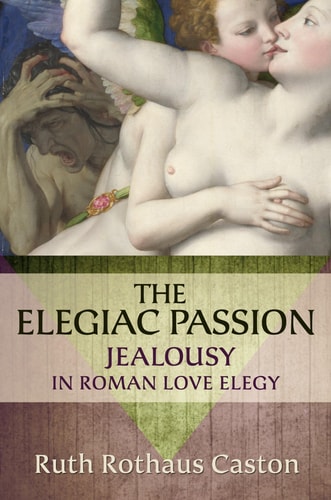
The Elegiac Passion: Jealousy in Roman Love Elegy
0
0
As an Amazon Associate and affiliate partner, Menrva Books earns from qualifying purchases. Learn more
Author Description
The passions were a topic of widespread interest in antiquity, as has been shown by the recent interest and research in the emotions in Greek and Roman literature. Until now, however, there has been very little focus on love elegy or its relation to contemporary philosophical positions. Yet Roman love elegy depends crucially upon the passions: without love, anger, jealousy, pity, and fear, elegy could not exist at all. The Elegiac Passion provides the first investigation of the ancient representation of jealousy in its Roman context, as well as its significance for Roman love elegy itself. The poems of Propertius, Tibullus, and Ovid are built upon the presumed existence of a love triangle involving poet, mistress, and rival: the very structure of elegy thus creates an ideal scenario for the arousal of jealousy.This study begins by examining the differences between the elegiac treatment of love and that of philosophy, whether Stoic or Epicurean. Ruth Caston uses the main chapters to address the depiction of jealousy in the love relationship and explores in detail the role of the senses, the role of readers--both those internal and external to the poems--, and the use of violence as a response to jealousy. Elegy provides a multi-faceted perspective on jealousy that gives us details and nuances of the experience of jealousy not found elsewhere in ancient literature. She argues that jealousy turns centrally on the question of fides. The fear of broken obligations and the consequent lack of trust are relevant not only to the love affair that forms the subject of these poems but to many other relationships represented in elegy as well. Overall, she demonstrates that jealousy is not merely the subject matter of elegy: it creates and structures elegy's various generic features. Jealousy thus provides a much more satisfying explanation for the specific character of Roman elegy than the various theories about its origins that have typically been put forward.
Menrva's Summary
THE THESIS
This book investigates how the emotion of jealousy functions as a foundational structural and thematic element within Roman love elegy. Ruth R. Caston, a scholar of classical literature, utilizes a comparative framework to analyze the works of Propertius, Tibullus, and Ovid. By contrasting elegiac representations of passion with contemporary Stoic and Epicurean philosophical doctrines, the author argues that jealousy is not merely a poetic subject but the primary mechanism that defines the genre's generic conventions and internal logic.
THE SCOPE MAP
What You Will Find
- Comparative analysis of Roman love elegy against Stoic and Epicurean philosophical texts.
- Examination of the role of the senses and the function of internal and external readers in poetic reception.
- Investigation into the connection between jealousy, violence, and the concept of fides (trust/obligation).
- Detailed study of the love triangle motif involving the poet, the mistress, and the rival.
THE AUTHORITY PERSPECTIVE
Scholars recognize this work as a significant contribution to the study of emotions in antiquity, specifically for its focus on the intersection of philosophy and poetic structure. Readers frequently note the academic density of the prose and the author's precise application of classical philology to the elegiac tradition.
Page Count:
192
Publication Date:
2012-09-03
Publisher:
Oxford University Press
ISBN-10:
0199925909
ISBN-13:
9780199925902
History
Poetry
Philosophy
Literary Criticism
Jealousy
Criticism history
Community Tags
Similar Books