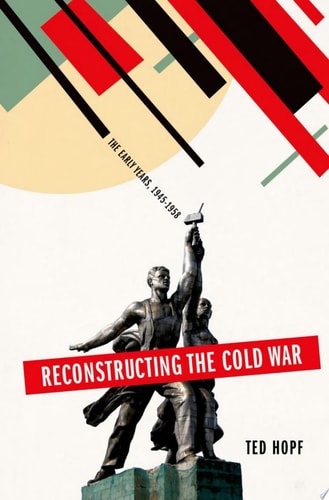
Reconstructing the Cold War: The Early Years, 1945-1958
0
0
As an Amazon Associate and affiliate partner, Menrva Books earns from qualifying purchases. Learn more
Author Description
General answers are hard to imagine for the many puzzling questions that are raised by Soviet relations with the world in the early years of the Cold War. Why was Moscow more frightened by the Marshall Plan than the Truman Doctrine? Why would the Soviet Union abandon its closest socialist ally, Yugoslavia, just when the Cold War was getting under way? How could Khrushchev's de-Stalinized domestic and foreign policies at first cause a warming of relations with China, and then lead to the loss of its most important strategic ally? What can explain Stalin's failure to ally with the leaders of the decolonizing world against imperialism and Khrushchev's enthusiastic embrace of these leaders as anti-imperialist at a time of the first detente of the Cold War? It would seem that only idiosyncratic explanations could be offered for these seemingly incoherent policy outcomes. Or, at best, they could be explained by the personalities of Stalin and Khrushchev as leaders. The latter, although plausible, is incorrect. In fact, the most Stalinist of Soviet leaders, the secret police chief and sociopath, Lavrentii Beria, was the most enthusiastic proponent of de-Stalinized foreign and domestic policies after Stalin's death in March 1953.Ted Hopf argues, instead, that it was Soviet identity that explains these anomalies. During Stalin's rule, a discourse of danger prevailed in Soviet society, where any deviations from the idealized version of the New Soviet Man, were understood as threatening the very survival of the Soviet project itself. But the discourse of danger did not go unchallenged. Even under the rule of Stalin, Soviet society understood a socialist Soviet Union as a more secure, diverse, and socially democratic place. This discourse of difference, with its broader conception of what the socialist project meant, and who could contribute to it, was empowered after Stalin's death, first by Beria, then by Malenkov, and then by Khrushchev, and the rest of the post-Stalin Sovie
Menrva's Summary
THE THESIS
This book investigates how Soviet identity, rather than individual leadership or idiosyncratic policy, dictated the trajectory of Soviet foreign relations during the early Cold War. Ted Hopf, a scholar of international relations, challenges the conventional focus on the personalities of Stalin and Khrushchev. By analyzing internal Soviet discourse, he argues that the tension between a 'discourse of danger' and a 'discourse of difference' shaped the state's strategic decisions regarding allies and geopolitical rivals.
THE SCOPE MAP
What You Will Find
- Analysis of Soviet foreign policy shifts from 1945 to 1958.
- Examination of the ideological transition from Stalinism to post-Stalinist reforms.
- Case studies on relations with Yugoslavia, China, and decolonizing nations.
- Theoretical framework linking domestic social identity to international behavior.
THE AUTHORITY PERSPECTIVE
Scholars of Soviet history and international relations frequently cite this work for its innovative application of constructivist theory to Cold War diplomacy. Readers often note the academic density of the prose, which provides a rigorous alternative to traditional realist interpretations of Soviet statecraft.
Page Count:
316
Publication Date:
2012-01-01
Publisher:
Oxford University Press
ISBN-10:
0199930015
ISBN-13:
9780199930012
History
Cold War
Group Identity
International relations
European History
Social change
Soviet Union
Community Tags
Other Editions(2)

Similar Books

Reader Comments
Share Your Thoughts
No comments yet. Be the first to share your thoughts!