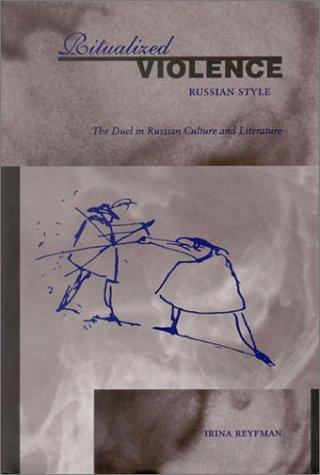
Ritualized Violence Russian Style
0
0
As an Amazon Associate and affiliate partner, Menrva Books earns from qualifying purchases. Learn more
Author Description
To this day, Russian cultural memory has preserved a glamorous image of the Russian duelist: a gentleman, he is always true to his honor; he elegantly challenges his offender for some equally elegant indiscretion, behaves courageously and magnanimously at the dueling site, and shows fortitude in the face of possible punishment - if he survives. In the Russian cultural imagination, dueling crossed the boundaries of purely aristocratic experience and acquired the status of heroic behavior representative of national character, as is shown in many works of literature and popular fiction, as well as scholarship."--BOOK JACKET. "This book argues that the Russian duel acquired its enduring prestige because it served to define and to defend personal autonomy in a hierarchical state that lacked legal guarantees against corporal punishment. To fight a tradition that tolerated superiors' punching and slapping their subordinates, Russian duelists embraced raw violence and incorporated it into dueling procedure, thus replacing the hierarchical - and therefore humiliating - violence of corporal punishment with the equalizing violence of the duel. Once made reciprocal, a punishing gesture (such as a slap in the face) lost its capacity to impose a hierarchy of authority and became a means of promoting equality between the parties."--BOOK JACKET.
Menrva's Summary
THE THESIS
This book investigates how the ritual of the duel in Russia became a defining element of national character and personal autonomy within a rigid, hierarchical state. The author argues that the duel's prestige stemmed from its role in defending individual autonomy in a system lacking legal protections against arbitrary physical punishment. By embracing raw violence and making it reciprocal, Russian duelists transformed humiliating, hierarchical corporal punishment into an equalizing force, thereby asserting personal freedom and dignity.
THE SCOPE MAP
- Analysis of the romanticized image of the Russian duelist in cultural memory.
- Exploration of how dueling transcended aristocratic circles to represent heroic, national behavior.
- Argument that the duel served as a defense of personal autonomy in a state lacking legal guarantees.
- Examination of how raw violence was incorporated into dueling procedures.
- Discussion of how reciprocal violence in duels replaced hierarchical corporal punishment with an equalizing force.
- Analysis of the duel's role in promoting equality between participants, regardless of social standing.
- Connection between dueling rituals and the broader Russian cultural imagination.
THE AUTHORITY PERSPECTIVE
This scholarly work examines the historical and cultural significance of dueling in Russia, positing that it served as a crucial mechanism for asserting personal autonomy within a state that lacked robust legal protections. The book analyzes how the ritualized violence of the duel, by becoming reciprocal, effectively leveled social hierarchies and offered a means of defending honor and dignity. The author draws on literary and historical sources to illustrate how dueling became embedded in the Russian cultural imagination as a representation of national character.
Page Count:
364
Publication Date:
1999-01-01
ISBN-10:
0804734127
ISBN-13:
9780804734127
Non-Fiction
History
Social History
Russian History
Community Tags
Similar Books