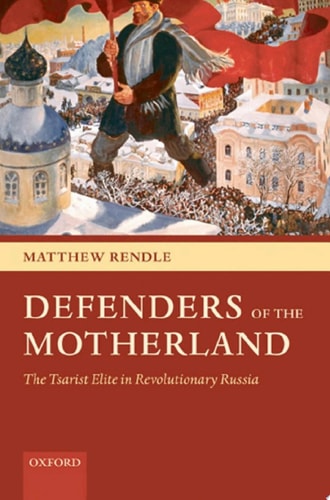
Defenders of the Motherland: The Tsarist Elite in Revolutionary Russia
0
0
As an Amazon Associate and affiliate partner, Menrva Books earns from qualifying purchases. Learn more
Author Description
Defenders of the Motherland studies how the most powerful social groups in tsarist Russia reacted to the challenges posed by the Russian Revolutions of 1917. Arguing that elite groups-especially nobles, landowners, and officers-played an important role in these events, Matthew Rendle shows how the alienation of tsarist elites from the tsar during the First World War and their support for the new Provisional Government in February 1917 secured the initial success of the revolution. Elites engaged actively with revolutionary politics, serving in the government and forming unions to promote their interests and gather wider support. In doing so, they fostered fears of counter-revolution amongst the lower social classes, radicalizing the popular mood and paving the way for the Bolsheviks. Although increasingly disillusioned with events, elites were not solely counter-revolutionary and were far from united. A poorly-supported military revolt in August 1917 demonstrated different aspirations for the future, whilst as many served the Bolshevik regime after October 1917 as opposed it. The divisions that had existed prior to 1917, exacerbated by the revolution, consequently undermined the White armies' opposition to Bolshevism during Russia's civil war. Nevertheless, the Bolsheviks' fear of 'class enemies' was endemic, and their obsession with removing the threat that former elites posed laid the foundations of the violent and repressive Soviet regime.
Menrva's Summary
THE THESIS
This work investigates how the elite social strata of tsarist Russia navigated the political collapse of 1917 and the subsequent rise of the Bolshevik regime. Matthew Rendle, a historian specializing in Russian revolutionary politics, utilizes archival research and primary source analysis to argue that the actions and internal divisions of the nobility, landowners, and military officers were instrumental in both the initial success of the revolution and the eventual consolidation of Soviet power. The book posits that the elites were not a monolithic counter-revolutionary block, but rather a fractured group whose shifting allegiances and political engagement inadvertently radicalized the popular mood.
THE SCOPE MAP
What You Will Find
- Analysis of the political activities of the Russian nobility and officer corps during 1917.
- Examination of elite participation in the Provisional Government and various interest unions.
- Assessment of the impact of elite behavior on the radicalization of the lower social classes.
- Evaluation of the internal divisions that hindered the effectiveness of White armies during the Civil War.
Scope Limits
- The study does not provide a comprehensive military history of the Russian Civil War.
- The text focuses primarily on the elite perspective rather than the grassroots experience of the peasantry or urban proletariat.
THE AUTHORITY PERSPECTIVE
Scholars recognize this text as a nuanced contribution to the historiography of the Russian Revolution, particularly for its focus on the agency of the elite classes. Readers frequently note the academic density of the prose, which is well-suited for students and researchers of early twentieth-century Russian political history.
Page Count:
287
Publication Date:
2009-01-01
Publisher:
OUP Oxford
ISBN-10:
0191608017
ISBN-13:
9780191608018
History
Social History
history russia
Political History
Soviet Union
Military History
Russian History
Revolutionary Studies
European History
Community Tags
Similar Books