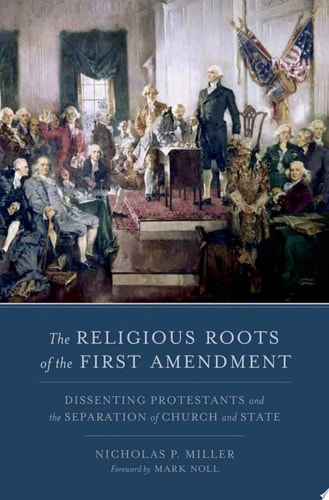
The Religious Roots of the First Amendment: Dissenting Protestants and the Separation of Church and State
0
0
As an Amazon Associate and affiliate partner, Menrva Books earns from qualifying purchases. Learn more
Author Description
Traditional understandings of the genesis of the separation of church and state rest on assumptions about "Enlightenment" and the republican ethos of citizenship. In The Religious Roots of the First Amendment, Nicholas P. Miller does not seek to dislodge that interpretation but to augment and enrich it by recovering its cultural and discursive religious contexts--specifically the discourse of Protestant dissent. He argues that commitments by certain dissenting Protestants to the right of private judgment in matters of Biblical interpretation, an outgrowth of the doctrine of the priesthood of all believers, helped promote religious disestablishment in the early modern West. This movement climaxed in the disestablishment of religion in the early American colonies and nation. Miller identifies a continuous strand of this religious thought from the Protestant Reformation, across Europe, through the English Reformation, Civil War, and Restoration, into the American colonies. He examines seven key thinkers who played a major role in the development of this religious trajectory as it came to fruition in American political and legal history: William Penn, John Locke, Elisha Williams, Isaac Backus, William Livingston, John Witherspoon, and James Madison. Miller shows that the separation of church and state can be read, most persuasively, as the triumph of a particular strand of Protestant nonconformity-that which stretched back to the Puritan separatist and the Restoration sects, rather than to those, like Presbyterians, who sought to replace the "wrong" church establishment with their own, "right" one. The Religious Roots of the First Amendment contributes powerfully to the current trend among some historians to rescue the eighteenth-century clergymen and religious controversialists from the enormous condescension of posterity.
Menrva's Summary
THE THESIS
This book investigates how the theological commitments of dissenting Protestants served as a primary catalyst for the development of the separation of church and state in the American constitutional tradition. Nicholas P. Miller, a scholar of law and history, challenges the secular-centric view of the First Amendment by tracing a specific intellectual lineage from the Protestant Reformation through the American founding. He argues that the doctrine of the priesthood of all believers and the right of private judgment created a religious framework that necessitated disestablishment. By analyzing the writings of seven key figures, Miller demonstrates that the American legal structure emerged from a long-standing tradition of religious nonconformity rather than solely from Enlightenment secularism.
THE SCOPE MAP
What You Will Find
- A historical analysis of the Protestant Reformation, the English Civil War, and the American colonial period.
- A detailed examination of the political and religious thought of William Penn, John Locke, Elisha Williams, Isaac Backus, William Livingston, John Witherspoon, and James Madison.
- A methodological focus on the discourse of Protestant dissent and the evolution of the doctrine of the priesthood of all believers.
- A legal and historical argument regarding the origins of religious disestablishment in the United States.
THE AUTHORITY PERSPECTIVE
Scholars and historians recognize this work as a significant contribution to the ongoing debate regarding the religious origins of American constitutional law. Readers frequently note the academic density of the prose and the author's meticulous attention to primary source documents from the early modern period.
Page Count:
272
Publication Date:
2012-01-01
Publisher:
Oxford University Press
ISBN-10:
0199942803
ISBN-13:
9780199942800
Religion
History
Politics
American History
Protestantism
Law
Community Tags
Similar Books