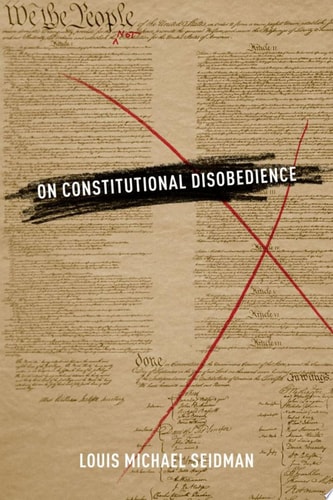
On Constitutional Disobedience (Inalienable Rights)
0
0
As an Amazon Associate and affiliate partner, Menrva Books earns from qualifying purchases. Learn more
Author Description
What would the Framers of the Constitution make of multinational corporations? Nuclear weapons? Gay marriage? They led a preindustrial country, much of it dependent on slave labor, huddled on the Atlantic seaboard. The Founders saw society as essentially hierarchical, led naturally by landed gentry like themselves. Yet we still obey their commands, two centuries and one civil war later. According to Louis Michael Seidman, it's time to stop. In On Constitutional Disobedience, Seidman argues that, in order to bring our basic law up to date, it needs benign neglect. This is a highly controversial assertion. The doctrine of "original intent" may be found on the far right, but the entire political spectrum--left and right--shares a deep reverence for the Constitution. And yet, Seidman reminds us, disobedience is the original intent of the Constitution. The Philadelphia convention had gathered to amend the Articles of Confederation, not toss them out and start afresh. The "living Constitution" school tries to bridge the gap between the framers and ourselves by reinterpreting the text in light of modern society's demands. But this attempt is doomed, Seidman argues. One might stretch "due process of law" to protect an act of same-sex sodomy, yet a loyal-but-contemporary reading cannot erase the fact that the Constitution allows a candidate who lost the popular election to be seated as president. And that is only one of the gross violations of popular will enshrined in the document. Seidman systematically addresses and refutes the arguments in favor of Constitutional fealty, proposing instead that it be treated as inspiration, not a set of commands. The Constitution is, at its best, a piece of poetry to liberty and self-government. If we treat it as such, the author argues, we will make better progress in achieving both.
Menrva's Summary
THE THESIS
Louis Michael Seidman investigates whether the modern American political system should continue to adhere to the rigid commands of an eighteenth-century document or treat the Constitution as a source of inspiration rather than binding law. Seidman, a professor of constitutional law, utilizes historical analysis of the Philadelphia Convention and contemporary political case studies to argue that constitutional veneration hinders democratic progress. He posits that the document's inherent contradictions and outdated hierarchies prevent the nation from addressing modern challenges effectively. By advocating for constitutional disobedience, he suggests that society should prioritize current popular will over the original intent of the Framers.
THE SCOPE MAP
What You Will Find
- Historical analysis of the Philadelphia Convention and the transition from the Articles of Confederation.
- A critique of the "living Constitution" interpretive framework.
- Examination of modern political issues including electoral college outcomes and social rights.
- A proposed shift in legal philosophy from mandatory fealty to inspirational guidance.
THE AUTHORITY PERSPECTIVE
Legal scholars and political commentators frequently note the provocative nature of Seidman's argument, which challenges the foundational consensus of American governance. Experts highlight this text as a significant contribution to debates regarding judicial review and the limits of originalism in a modern democratic context.
Page Count:
176
Publication Date:
2013-01-01
Publisher:
Oxford University Press
ISBN-10:
0199969698
ISBN-13:
9780199969692
Politics
Philosophy
Law
Constitutional Law
Constitutions
United States
Community Tags
Other Editions(2)

Similar Books
Reader Comments
Share Your Thoughts
No comments yet. Be the first to share your thoughts!