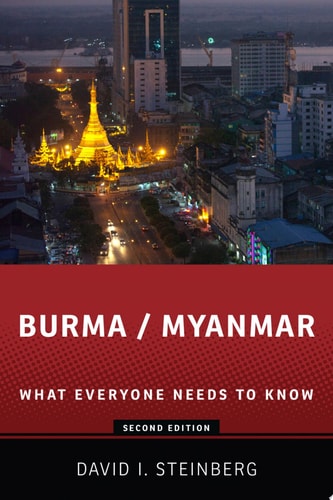
Burma/Myanmar: What Everyone Needs to Know
0
0
As an Amazon Associate and affiliate partner, Menrva Books earns from qualifying purchases. Learn more
Author Description
No country in Asia in recent years has undergone so massive a political shift in so short a time as Myanmar. Until recently, the former British colony had one of the most secretive, corrupt, and repressive regimes on the planet, a country where Nobel Peace Prize laureate Aung San Suu Kyi was held in continual house arrest and human rights were denied to nearly all. Yet events in Myanmar since the elections of November 2010 have profoundly altered the internal mood of the society, and have surprised even Burmese and seasoned foreign observers of the Myanmar scene. The pessimism that pervaded the society prior to the elections, and the results of that voting that prompted many foreign observers to call them a "sham" or "fraud," gradually gave way to the realization that positive change was in the air. In this updated second edition of Burma/Myanmar: What Everyone Needs to Know®, Davd I. Steinberg addresses the dramatic changes in the country over the past two years, including the establishment of a human rights commission, the release of political prisoners, and reforms in health and education. More than ever, the history, culture, and internal politics of this country are crucial to understanding the current transformation, which has generated headlines across the globe. Geographically strategic, Burma/Myanmar lies between the growing powers of China and India. Yet it is mostly unknown to Westerners despite being its thousand-year history as a nation. Burma/Myanmar is a place of contradictions: a picturesque land with mountain jungles and monsoon plains, it is one of the world's largest producers of heroin. Though it has extensive natural resources including oil, gas, teak, metals, and minerals, it is one of the poorest countries in the world. And despite a half-century of military-dominated rule, change is beginning to work its way through the beleaguered nation, as it moves to a more pluralistic administrative system reflecting its pluralistic cultural and multi-et
Menrva's Summary
THE THESIS
This book investigates the complex political, social, and historical factors driving Myanmar's rapid transition from a repressive military regime to a more pluralistic administrative system. David I. Steinberg, a seasoned expert on Burmese affairs, utilizes his extensive background in regional studies to synthesize the country's recent reforms against the backdrop of its long-standing internal contradictions. The text argues that understanding Myanmar's current trajectory requires a deep examination of its historical isolation, its strategic geopolitical position between China and India, and the systemic challenges of its economic and social development.
THE SCOPE MAP
What You Will Find
- Analysis of the political shifts following the 2010 elections and subsequent reform efforts.
- Examination of the historical context of military-dominated rule and its impact on modern governance.
- Discussion of the country's geopolitical significance as a buffer state between regional powers.
- Assessment of the paradox between the nation's vast natural resource wealth and its persistent poverty.
THE AUTHORITY PERSPECTIVE
Experts and scholars frequently cite this work as a reliable, accessible primer for those seeking to understand the complexities of Myanmar's political landscape. Readers note that the prose remains clear and objective, providing a necessary foundation for navigating the country's rapid and often unpredictable institutional changes.
Page Count:
315
Publication Date:
2013-01-01
Publisher:
Oxford University Press
ISBN-10:
0199981701
ISBN-13:
9780199981700
History
Public Administration
Asian Studies
Asian History
Myanmar
International relations
Burma
Community Tags
Similar Books