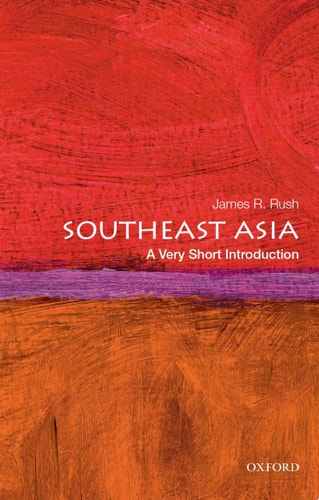
Southeast Asia: A Very Short Introduction (Very Short Introductions)
0
0
As an Amazon Associate and affiliate partner, Menrva Books earns from qualifying purchases. Learn more
Author Description
The eleven countries of Southeast Asia are diverse in every way, from the ethnicities and religions of their residents to their political systems and levels of prosperity. These nations--Myanmar, Thailand, Malaysia, Indonesia, Vietnam, Singapore, the Philippines, Laos, Cambodia, Brunei, and East Timor--are each undeniably unique, yet the vestiges of their shared traditions mean that each country is also characteristically Southeast Asian.In Southeast Asia: A Very Short Introduction, James R. Rush traces the history of the region, beginning with its earliest settled communities (ca. 3000 BCE) through its long classical period of "mandala" kingdoms. Rush then delves into the four centuries of colonial penetration, from the Portuguese invasion of Melaka in 1511 to the Japanese conquest of the colonies in World War II. This is followed by discussion of the subsequent independence movements and the Vietnam War. Rush also traces the history of the region's relations with India and China--he tells the story of the foundation and evolution of the region-defining Association for Southeast Asian Nations (ASEAN), explaining how all these events helped shape the countries of Southeast Asia into the stable nations we know today: democracies, dictatorships, and constitutional monarchies alike. Rush covers the recent ethno-religious violence in Myanmar, military rule and democratization in Indonesia, the environmental consequences of agribusiness and unchecked urbanization, and big-power alignments and tensions involving the United States, China, and Japan. A synthesis of the research and insights of leading scholars, Southeast Asia: A Very Short Introduction provides an easy-to-grasp analysis of contemporary Southeast Asia that accommodates its bewildering ethnic, religious, and political complexities while exposing the underlying patterns that make it a recognizable world region.ABOUT THE SERIES: The Very Short Introductions series from Oxford University Press contains hundreds
Menrva's Summary
THE THESIS
This book investigates the historical, cultural, and political forces that define Southeast Asia as a distinct yet diverse world region. James R. Rush, a historian specializing in Southeast Asian studies, synthesizes centuries of regional development to explain how eleven unique nations evolved from ancient mandala kingdoms into their current political configurations. By examining the interplay between indigenous traditions and external influences, the author provides a framework for understanding the region's contemporary stability and ongoing challenges.
THE SCOPE MAP
What You Will Find
- Historical timeline from 3000 BCE to the modern era
- Analysis of colonial impacts and independence movements
- Examination of the formation and evolution of ASEAN
- Discussion of contemporary issues including urbanization, environmental impact, and ethno-religious tensions
Scope Limits
- Does not provide exhaustive country-by-country biographies
- Does not offer detailed economic forecasting or granular policy prescriptions
THE AUTHORITY PERSPECTIVE
Experts and readers recognize this text as a concise, high-level overview suitable for students and general readers seeking a foundational understanding of the region. The prose is noted for its ability to distill complex geopolitical and historical narratives into an accessible format without sacrificing academic rigor.
Page Count:
160
Publication Date:
2018-01-01
Publisher:
Oxford University Press
ISBN-10:
0190248785
ISBN-13:
9780190248789
History
Geography
Asian Studies
Asian History
International relations
Ethnic Studies
Southeast Asia
Community Tags
Similar Books