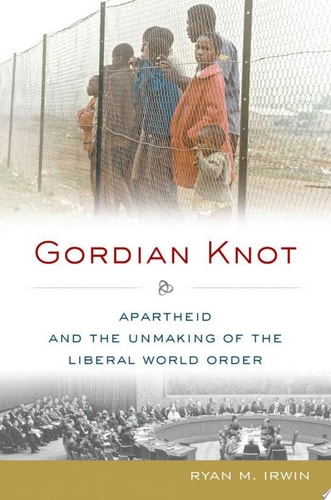
Gordian Knot: Apartheid and the Unmaking of the Liberal World Order (Oxford Studies in International History)
0
0
As an Amazon Associate and affiliate partner, Menrva Books earns from qualifying purchases. Learn more
Author Description
Writing more than one hundred years ago, African American scholar W.E.B. Du Bois speculated that the great dilemma of the twentieth century would be the problem of "the color line." Nowhere was the dilemma of racial discrimination more entrenched-and more complex-than South Africa. Gordian Knot examines South Africa's freedom struggle in the years surrounding African decolonization, using the global apartheid debate to explore the way new nation-states changed the international community during the mid-twentieth century. At the highpoint of decolonization, South Africa's problems shaped a transnational conversation about nationhood. Arguments about racial justice, which crested as Europe relinquished imperial control of Africa and the Caribbean, elided a deeper contest over the meaning of sovereignty, territoriality, and development. Based on research in African, American, and European archives, Gordian Knot advances a bold new interpretation about African decolonization's relationship to American power. In so doing, it promises to shed light on U.S. foreign relations with the Third World and recast understandings of the fate of liberal internationalism after World War II.
Menrva's Summary
THE THESIS
This book investigates how the global debate surrounding South African apartheid fundamentally reshaped the international order and the meaning of sovereignty during the mid-twentieth century. Ryan M. Irwin, a historian of international relations, utilizes extensive archival research from Africa, the United States, and Europe to challenge traditional narratives of decolonization. He argues that the struggle against apartheid was not merely a regional conflict but a central catalyst that forced a redefinition of liberal internationalism and American power in the post-World War II era.
THE SCOPE MAP
What You Will Find
- Analysis of the intersection between African decolonization and U.S. foreign policy.
- Examination of the shifting definitions of sovereignty, territoriality, and development in the mid-twentieth century.
- Primary source evidence drawn from multi-national archives across three continents.
- A critical assessment of how the 'color line' dilemma influenced the evolution of the liberal world order.
THE AUTHORITY PERSPECTIVE
Scholars in the field of international history recognize this work as a rigorous contribution to the study of post-war diplomacy and the global impact of the anti-apartheid movement. Readers frequently note the academic density of the prose and the author's success in connecting local South African struggles to broader, global geopolitical shifts.
Page Count:
256
Publication Date:
2012-01-01
Publisher:
Oxford University Press
ISBN-10:
0199996172
ISBN-13:
9780199996179
History
South Africa
Diplomatic History
International relations
Decolonization
African history
Community Tags
Similar Books