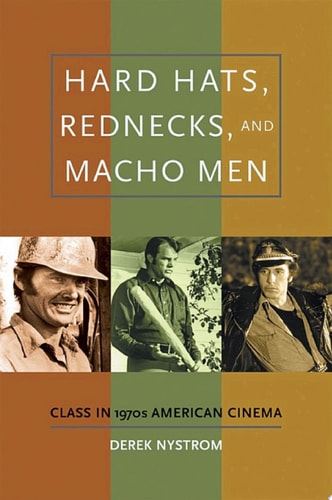
Hard Hats, Rednecks, and Macho Men: Class in 1970s American Cinema
0
0
As an Amazon Associate and affiliate partner, Menrva Books earns from qualifying purchases. Learn more
Author Description
Everywhere you look in 1970s American cinema, you find white working-class men. They bring a violent conclusion to Easy Rider, murdering the film's representatives of countercultural alienation and disaffection. They lurk in the Georgia woods of Deliverance, attacking outsiders in a manner that evokes the South's recent history of racial violence and upheaval. They haunt the singles nightclubs of Looking for Mr. Goodbar, threatening the film's newly liberated heroine with patriarchal violence. They strut through the disco clubs of Saturday Night Fever, dancing to music whose roots in post-Stonewall homosexuality invite ambiguity that the men ignore. Hard Hats, Rednecks, and Macho Men argues that the persistent appearance of working-class characters in these and other films of the 1970s reveals the powerful role class played in the key social and political developments of the decade, such as the decline of the New Left and counterculture, the re-emergence of the South as the Sunbelt, and the rise of the women's and gay liberation movements. Examining the "youth cult" film, the neo-Western "southern," and the "new nightlife" film, Nystrom shows how these cinematic renderings of white working-class masculinity actually tell us more about the crises facing the middle class during the 1970s than about working-class experience itself. Hard Hats thus demonstrates how these representations of the working class serve as fantasies about a class Other-fantasies that offer imaginary resolutions to middle-class anxieties provoked by the decade's upheavals. Drawing on examples of iconic films from the era-Saturday Night Fever, Cruising, Five Easy Pieces, and Walking Tall, among others-Nystrom presents an incisive, evocative study of class and American cinema during one of the nation's most tumultuous decades.
Menrva's Summary
THE THESIS
This book investigates how the recurring figure of the white working-class male in 1970s American cinema functioned as a projection of middle-class anxieties rather than an accurate depiction of laboring-class life. Derek Nystrom, an academic specializing in cultural studies, utilizes a framework of film analysis and social history to argue that these cinematic representations served as fantasies used to navigate the political and social upheavals of the decade. By examining the decline of the counterculture and the rise of new social movements, the author demonstrates how the era's films mediated complex class tensions.
THE SCOPE MAP
What You Will Find
- Analysis of subgenres including the youth cult film, the neo-Western, and the new nightlife film.
- Examination of iconic 1970s films such as Saturday Night Fever, Deliverance, and Five Easy Pieces.
- Theoretical application of class-based cultural criticism to cinematic character archetypes.
Scope Limits
- The text does not provide a comprehensive history of the actual American working class during the 1970s.
- The analysis is primarily focused on white masculinity and does not extensively cover non-white working-class representations.
THE AUTHORITY PERSPECTIVE
Scholars in film and cultural studies frequently cite this work for its rigorous application of class theory to popular media. Readers often note the academic density of the prose, which is well-suited for university-level research and critical film analysis.
Page Count:
263
Publication Date:
2009-01-01
Publisher:
Oxford University Press
ISBN-10:
0190450665
ISBN-13:
9780190450663
History
Sociology
Film Studies
American Studies
Cultural History
1970s Cinema
American History
Motion pictures
Class Studies
Community Tags
Similar Books