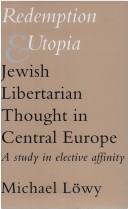
Redemption and Utopia
0
0
As an Amazon Associate and affiliate partner, Menrva Books earns from qualifying purchases. Learn more
Author Description
Towards the end of the nineteenth century, there appeared in Central Europe a generation of Jewish intellectuals whose work was to transform modern culture. Drawing at once on the traditions of German Romanticism and Jewish messianism, their thought was organized around the cabalistic idea of the “tikkoun”: redemption. Redemption and Utopia uses the concept of “elective affinity” to explain the surprising community of spirit that existed between redemptive messianic religious thought and the wide variety of radical secular utopian beliefs held by this important group of intellectuals. The author outlines the circumstances that produced this unusual combination of religious and non-religious thought and illuminates the common assumptions that united such seemingly disparate figures as Martin Buber, Franz Kafka, Walter Benjamin and Georg Lukács.
Menrva's Summary
THE THESIS
This book investigates the intellectual currents of late 19th-century Central European Jewish intellectuals who synthesized German Romanticism and Jewish messianism around the concept of 'tikkoun' or redemption. Michael Löwy employs the idea of 'elective affinity' to explore the shared spiritual community between religious messianic thought and radical secular utopian beliefs. The work details the specific circumstances that fostered this unique blend of religious and secular ideas, highlighting the common ground shared by figures such as Martin Buber, Franz Kafka, Walter Benjamin, and Georg Lukács.
THE SCOPE MAP
- Exploration of the concept of 'tikkoun' (redemption) in Jewish intellectual thought.
- Analysis of the 'elective affinity' between religious messianism and secular utopianism.
- Examination of the intellectual milieu of Central European Jewish intellectuals.
- Case studies of key figures including Martin Buber, Franz Kafka, Walter Benjamin, and Georg Lukács.
- Discussion of the influence of German Romanticism on this intellectual generation.
- Contextualization of the historical and cultural factors that shaped their ideas.
- Illumination of the common assumptions underlying their diverse works.
THE AUTHORITY PERSPECTIVE
The book is recognized for its insightful analysis of a pivotal generation of Jewish intellectuals and their complex relationship with redemption and utopia. Löwy's application of 'elective affinity' provides a compelling framework for understanding the convergence of religious and secular thought in figures like Buber, Kafka, Benjamin, and Lukács. The work is valued for its deep engagement with both traditional Jewish concepts and radical political philosophies. It offers a nuanced perspective on how these intellectuals forged a unique intellectual legacy that continues to resonate.
Page Count:
303
Publication Date:
1997-01-01
ISBN-10:
3879562156
ISBN-13:
9783879562152
Non-Fiction
Philosophy
Religion
History
Jewish Studies
Intellectual History
Messianism
Community Tags
Similar Books