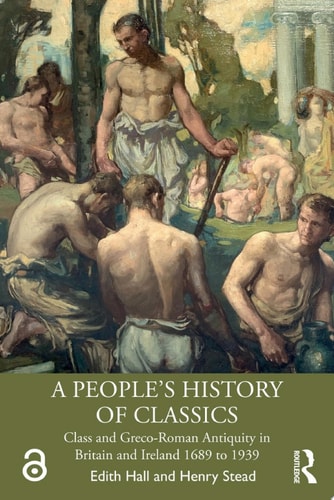
A People's History of Classics
0
0
As an Amazon Associate and affiliate partner, Menrva Books earns from qualifying purchases. Learn more
Author Description
A People’s History of Classics explores the influence of the classical past on the lives of working-class people, whose voices have been almost completely excluded from previous histories of classical scholarship and pedagogy, in Britain and Ireland from the late 17th to the early 20th century. This volume challenges the prevailing scholarly and public assumption that the intimate link between the exclusive intellectual culture of British elites and the study of the ancient Greeks and Romans and their languages meant that working-class culture was a ‘Classics-Free Zone’. Making use of diverse sources of information, both published and unpublished, in archives, museums and libraries across the United Kingdom and Ireland, Hall and Stead examine the working-class experience of classical culture from the Bill of Rights in 1689 to the outbreak of World War II. They analyse a huge volume of data, from individuals, groups, regions and activities, in a huge range of sources including memoirs, autobiographies, Trade Union collections, poetry, factory archives, artefacts and documents in regional museums. This allows a deeper understanding not only of the many examples of interaction with the Classics, but also what these cultural interactions signified to the working poor: from the promise of social advancement, to propaganda exploited by the elites, to covert and overt class war. A People’s History of Classics offers a fascinating and insightful exploration of the many and varied engagements with Greece and Rome among the working classes in Britain and Ireland, and is a must-read not only for classicists, but also for students of British and Irish social, intellectual and political history in this period. Further, it brings new historical depth and perspectives to public debates around the future of classical education, and should be read by anyone with an interest in educational policy in Britain today.
Menrva's Summary
THE THESIS
This book investigates the overlooked influence of classical antiquity on the lives of working-class people in Britain and Ireland. It challenges the assumption that classical studies were exclusively an elite pursuit by examining how individuals from diverse socioeconomic backgrounds engaged with Greek and Roman culture from the late 17th to the early 20th centuries. The authors utilize a wide array of archival materials, personal accounts, and cultural artifacts to demonstrate the varied significance of these interactions, ranging from aspirations for social mobility to tools of elite propaganda and expressions of class struggle.
THE SCOPE MAP
- Exploration of working-class engagement with classical culture in Britain and Ireland from 1689 to World War II.
- Analysis of diverse sources including memoirs, autobiographies, Trade Union records, poetry, and factory archives.
- Examination of interactions with classical languages and texts among non-elite populations.
- Investigation into the promise of social advancement offered by classical knowledge.
- Analysis of how elites used classical references for propaganda and social control.
- Study of covert and overt class warfare as reflected in engagements with the Classics.
- Contribution to public debates on the future of classical education and educational policy.
THE AUTHORITY PERSPECTIVE
The book offers a significant re-evaluation of classical reception by centering the experiences of the working classes, a perspective historically marginalized in scholarship. It draws on extensive archival research across the United Kingdom and Ireland to present a nuanced picture of how ancient Greece and Rome resonated beyond elite circles. The work is positioned as essential reading for classicists, historians of British and Irish social, intellectual, and political history, and those interested in contemporary educational policy.
Page Count:
670
Publication Date:
2020-02-26
Publisher:
Taylor & Francis
ISBN-10:
1315446588
ISBN-13:
9781315446585
History
Non-Fiction
Classics
Education
Class Studies
Cultural History
Social History
Community Tags
Similar Books