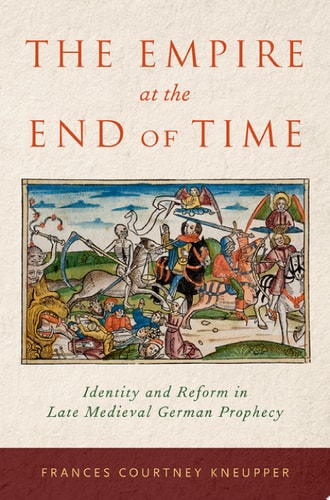
The Empire at the End of Time
0
0
As an Amazon Associate and affiliate partner, Menrva Books earns from qualifying purchases. Learn more
Author Description
In this book, Frances Courtney Kneupper examines the apocalyptic prophecies of the late medieval Empire, which even within the sensational genre of eschatological prophecy stand out for their bitter and violent nature. In addition to depicting the savage chastisement of the clergy and the forcible restructuring of the Church, these prophecies also infuse the apocalyptic narrative with explicitly German elements-in fact, German speakers are frequently cast as the agents of these stirring events in which the clergy suffer tribulations and the Church hierarchy is torn down.These prophecies were widely circulated throughout late medieval German-speaking Europe. Kneupper explores their significance for members of the Empire from 1380 to 1480, arguing that increased literacy, the development of strong urban centers, the drive for reform, and a connection to the imperial crown were behind their popularity. Offering detailed accounts of the most significant prophecies, Kneupper shows how they fit into currents of thought and sentiment in the late medieval Empire. In particular, she considers the relationships of German prophecy to contemporary discourses on Church reform and political identity. She finds that eschatological thought was considered neither marginal nor heretical, but was embraced by a significant, orthodox population of German laypeople and clerics, demonstrating the importance of popular eschatological thought to the development of a self-conscious, reform-minded, German-identified Empire on the Eve of the Reformation.
Menrva's Summary
THE THESIS
This book investigates the function and cultural significance of apocalyptic prophecies within the late medieval German Empire, specifically examining why these violent, reform-oriented texts gained widespread acceptance among orthodox populations. Frances Courtney Kneupper, a scholar of medieval history, utilizes a range of primary source prophecies to argue that these texts were not marginal or heretical, but rather central to the development of a distinct German political and religious identity. By situating these prophecies within the context of 14th and 15th-century urban growth and reform movements, she demonstrates how eschatological thought shaped the intellectual landscape leading up to the Reformation.
THE SCOPE MAP
What You Will Find
- Analysis of apocalyptic prophecies circulating in German-speaking Europe between 1380 and 1480.
- Examination of the intersection between eschatological thought, Church reform, and German national identity.
- Historical context regarding the rise of literacy and urban centers in the late medieval Empire.
Scope Limits
- The study focuses specifically on the German-speaking regions of the Empire and does not provide a comprehensive survey of pan-European apocalypticism.
- The analysis is restricted to the period between 1380 and 1480.
THE AUTHORITY PERSPECTIVE
Scholars recognize this work as a significant contribution to the study of late medieval religious culture and the intellectual precursors to the Reformation. Readers frequently note the academic rigor of the prose and the author's ability to synthesize complex primary source material into a coherent historical argument.
Page Count:
280
Publication Date:
2016-04-12
Publisher:
Oxford University Press
ISBN-10:
0190279362
ISBN-13:
9780190279363
History
Religion
Group Identity
Cultural History
European History
Eschatology
Community Tags
Similar Books