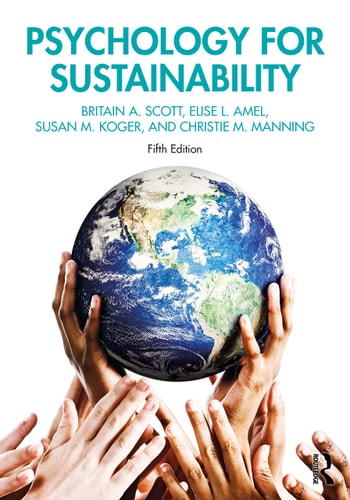
Psychology for Sustainability
0
0
As an Amazon Associate and affiliate partner, Menrva Books earns from qualifying purchases. Learn more
Author Description
Psychology for Sustainability applies psychological science to so-called environmental problems that manifest when human behavior disrupts and degrades natural systems. Drawing on environmental psychology, ecopsychology, conservation psychology, and related disciplines, the authors provide an extensive review of relevant theory and research in a lively and easy-to-read style. This edition represents a substantial revision and expansion spurred by a burgeoning body of research and by global ecological, political, and social developments. Particular attention is paid to environmental justice and collective action for systems change. More than one-third of the content is entirely new, and there are more than nine hundred new references. This edition also features a new full-color design and over two hundred full-color figures, tables, and photos. Timely topics include climate change, biodiversity loss, environmental racism, Indigenous perspectives, social media, and COVID-19 and other pandemics. Content retained from the previous edition has been updated throughout. The twelve chapters are organized into four parts: What on Earth Are We Doing includes a prologue on psychology as a sustainability science, followed by three chapters that provide an overview of the ecological crisis and its historical origins, and a vision for a sustainable future. Psychology for a Sustainable Future encompasses five chapters on research methods, theory, and findings pertinent to understanding and shifting unsustainable behavior. What's Good for the Planet is Good for Us includes two chapters that address the reciprocal relationship between planetary and human health. Being the Change We Want to See introduces two new chapters to inspire readers to take what they have learned and apply it as changemakers in the world. The first is about collective action for systemic change.
Menrva's Summary
THE THESIS
This book investigates how psychological science can be applied to address environmental problems caused by human behavior. The authors, drawing from environmental psychology, ecopsychology, and conservation psychology, offer a comprehensive review of theories and research in an accessible style. This revised edition incorporates recent global developments and a burgeoning body of research, with a significant portion of new content and references, including a new full-color design with numerous figures and tables. It addresses timely topics such as climate change, biodiversity loss, environmental justice, and the impact of pandemics, organizing the content into four parts that explore the ecological crisis, methods for shifting behavior, the link between planetary and human health, and the role of individuals as changemakers.
THE SCOPE MAP
- An overview of the ecological crisis, its historical origins, and a vision for a sustainable future.
- Research methods, theories, and findings pertinent to understanding and shifting unsustainable behavior.
- An exploration of the reciprocal relationship between planetary and human health.
- Guidance on collective action for systemic change and applying learned concepts as changemakers.
- Discussions on timely topics including climate change, biodiversity loss, environmental racism, Indigenous perspectives, social media, and pandemics.
- New full-color design with over two hundred full-color figures, tables, and photos.
THE AUTHORITY PERSPECTIVE
This edition represents a substantial revision and expansion, reflecting a burgeoning body of research and significant global ecological, political, and social developments. It pays particular attention to environmental justice and collective action for systems change, incorporating more than a third of entirely new content and over nine hundred new references. The inclusion of a new full-color design with extensive visual aids enhances its accessibility. The book addresses a wide array of contemporary issues, suggesting a comprehensive and up-to-date resource for understanding the intersection of psychology and sustainability.
Page Count:
430
Publication Date:
2021-01-01
Publisher:
Routledge
ISBN-10:
0367480697
ISBN-13:
9780367480691
Science
Non-Fiction
Social Issues
Social justice
Sustainability
Behavioral Science
Environmental Psychology
Ecology
Community Tags
Other Editions(3)


Similar Books






Reader Comments
Share Your Thoughts
No comments yet. Be the first to share your thoughts!