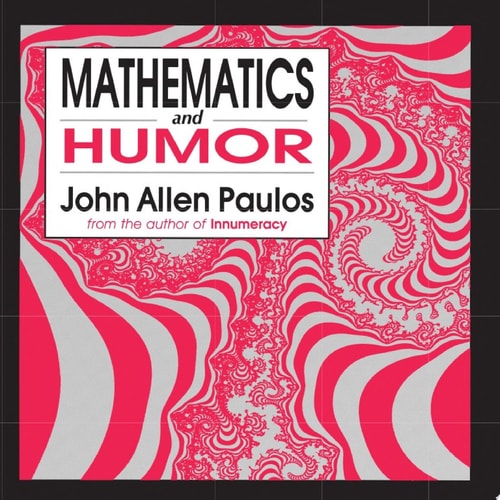
Mathematics and Humor
0
0
As an Amazon Associate and affiliate partner, Menrva Books earns from qualifying purchases. Learn more
Author Description
John Allen Paulos cleverly scrutinizes the mathematical structures of jokes, puns, paradoxes, spoonerisms, riddles, and other forms of humor, drawing examples from such sources as Rabelais, Shakespeare, James Beattie, René Thom, Lewis Carroll, Arthur Koestler, W. C. Fields, and Woody Allen. "Jokes, paradoxes, riddles, and the art of non-sequitur are revealed with great perception and insight in this illuminating account of the relationship between humor and mathematics."—Joseph Williams, New York Times "'Leave your mind alone,' said a Thurber cartoon, and a really complete and convincing analysis of what humour is might spoil all jokes forever. This book avoids that danger. What it does...is describe broadly several kinds of mathematical theory and apply them to throw sidelights on how many kinds of jokes work."—New Scientist "Many scholars nowadays write seriously about the ludicrous. Some merely manage to be dull. A few—like Paulos—are brilliant in an odd endeavor."—Los Angeles Times Book Review
Menrva's Summary
THE THESIS
This book investigates the mathematical underpinnings of humor and its various forms. John Allen Paulos, a mathematician known for his accessible writing on complex topics, examines how mathematical structures are inherent in jokes, puns, paradoxes, riddles, and other humorous expressions. Drawing on a wide range of literary and comedic sources, Paulos applies mathematical theories to illuminate the mechanics of how jokes function, exploring concepts like non-sequitur and logical fallacies within comedic contexts.
THE SCOPE MAP
- Analysis of mathematical structures within jokes and puns
- Exploration of paradoxes and their role in humor
- Examination of spoonerisms and other linguistic humor devices
- Application of mathematical theories to understand joke mechanisms
- Use of examples from Rabelais, Shakespeare, Lewis Carroll, W. C. Fields, Woody Allen, and others
- Discussion of the art of non-sequitur in humor
- Insights into the relationship between logic and the absurd
THE AUTHORITY PERSPECTIVE
The book is lauded for its perceptive and insightful examination of the connection between mathematics and humor, as noted by The New York Times. Reviewers from New Scientist and the Los Angeles Times Book Review highlight Paulos's ability to illuminate how various forms of jokes work through mathematical principles without spoiling the humor itself. The consensus suggests that Paulos brilliantly applies mathematical concepts to the study of the ludicrous, offering a unique and engaging perspective.
Page Count:
124
Publication Date:
2008-08-04
Publisher:
University of Chicago Press
ISBN-10:
0226650235
ISBN-13:
9780226650234
Non-Fiction
Philosophy
Humor
Science
Mathematics
Linguistics
Community Tags
Similar Books