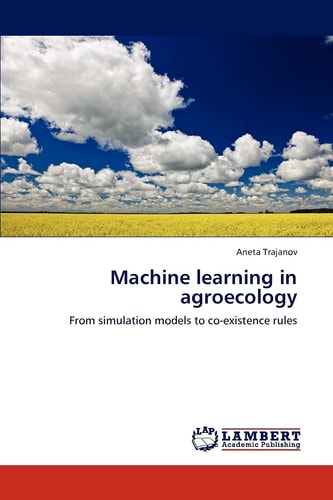
Machine Learning in Agroecology
0
0
As an Amazon Associate and affiliate partner, Menrva Books earns from qualifying purchases. Learn more
Author Description
Simulation models are a widely used tool for modelling systems for which it is hard to obtain real data. However, the simulation models are usually complex and it is not an easy task to induce new knowledge and find relationships and dependencies among different parts of the simulation model. Previous attempts to analyze the outputs from simulation models were mainly focused on speeding up the simulation process. In this monograph we are proposing a methodology for analyzing results of complex simulation models. The methodology combines simulation outputs, background knowledge, and machine learning, to obtain new and interesting knowledge about a certain problem of interest. We apply our methodology to three different simulation models that simulate the co-existence between genetically-modified and conventional crops at different levels. The induced machine learning models provide us with new co-existence knowledge about the positive and negative influences on the co-existence between genetically-modified and conventional crops. The results encourage us to try the same methodology on different types of simulation models and different scientific areas.
Menrva's Summary
THE THESIS
This monograph proposes a novel methodology for extracting new knowledge from complex simulation models by integrating simulation outputs with background knowledge and machine learning techniques. The author, Aneta Trajanov, addresses the challenge of analyzing intricate simulation models, which are often used when real-world data is scarce. The proposed methodology aims to overcome the difficulty of inducing new insights and identifying relationships within these models, moving beyond previous efforts focused solely on speeding up simulations. This work applies the methodology to three distinct simulation models concerning the co-existence of genetically-modified and conventional crops, yielding new knowledge about influencing factors.
THE SCOPE MAP
- A methodology for analyzing results of complex simulation models.
- Integration of simulation outputs, background knowledge, and machine learning.
- Application of the methodology to three simulation models of crop co-existence.
- Induced machine learning models providing insights into crop co-existence factors.
THE AUTHORITY PERSPECTIVE
The methodology presented in this monograph offers a promising approach for extracting knowledge from complex simulation models, particularly in scientific domains where empirical data is limited. The application to crop co-existence scenarios demonstrates the potential of combining simulation outputs with machine learning to uncover novel relationships and influences. The author's results suggest that this integrated approach could be valuable for analyzing diverse types of simulation models across various scientific fields, encouraging further exploration and adaptation of the proposed techniques.
Page Count:
140
Publication Date:
2011-09-01
Publisher:
Lap Lambert Academic Publishing GmbH KG
ISBN-10:
3845471336
ISBN-13:
9783845471334
Science
Non-Fiction
Scientific Research
Agroecology
Agriculture
Data Analysis
Machine Learning
Community Tags
Similar Books