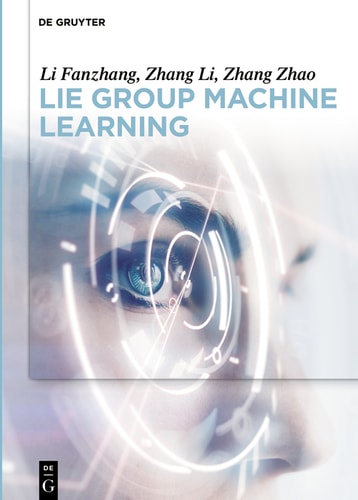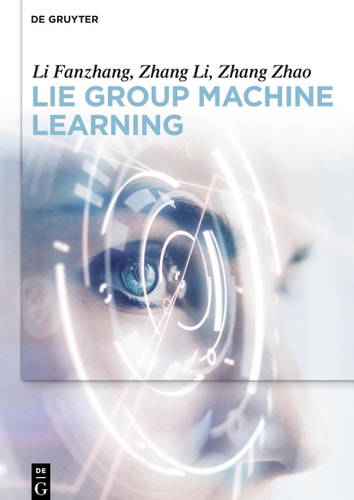
Lie Group Machine Learning
0
0
As an Amazon Associate and affiliate partner, Menrva Books earns from qualifying purchases. Learn more
Author Description
This book explains deep learning concepts and derives semi-supervised learning and nuclear learning frameworks based on cognition mechanism and Lie group theory. Lie group machine learning is a theoretical basis for brain intelligence, Neuromorphic learning (NL), advanced machine learning, and advanced artifi cial intelligence. The book further discusses algorithms and applications in tensor learning, spectrum estimation learning, Finsler geometry learning, Homology boundary learning, and prototype theory. With abundant case studies, this book can be used as a reference book for senior college students and graduate students as well as college teachers and scientific and technical personnel involved in computer science, artifi cial intelligence, machine learning, automation, mathematics, management science, cognitive science, financial management, and data analysis. In addition, this text can be used as the basis for teaching the principles of machine learning. Li Fanzhang is professor at the Soochow University, China. He is director of network security engineering laboratory in Jiangsu Province and is also the director of the Soochow Institute of industrial large data. He published more than 200 papers, 7 academic monographs, and 4 textbooks. Zhang Li is professor at the School of Computer Science and Technology of the Soochow University. She published more than 100 papers in journals and conferences, and holds 23 patents. Zhang Zhao is currently an associate professor at the School of Computer Science and Technology of the Soochow University. He has authored and co-authored more than 60 technical papers.
Menrva's Summary
THE THESIS
This book establishes Lie group machine learning as a foundational theory for advanced artificial intelligence and brain-inspired systems. The authors, professors with extensive research in computer science and data analysis, present deep learning concepts and derive semi-supervised and nuclear learning frameworks grounded in cognitive mechanisms and Lie group theory. The text explores algorithms and applications across tensor learning, spectrum estimation, Finsler geometry, Homology boundary learning, and prototype theory, supported by case studies. It is intended as a reference for advanced students, educators, and professionals in fields ranging from computer science to financial management.
THE SCOPE MAP
- Explanation of deep learning concepts.
- Derivation of semi-supervised learning frameworks based on cognition and Lie group theory.
- Derivation of nuclear learning frameworks based on cognition and Lie group theory.
- Discussion of Lie group machine learning as a theoretical basis for brain intelligence, Neuromorphic learning, advanced machine learning, and advanced artificial intelligence.
- Exploration of algorithms and applications in tensor learning.
- Exploration of algorithms and applications in spectrum estimation learning.
- Exploration of algorithms and applications in Finsler geometry learning.
- Exploration of algorithms and applications in Homology boundary learning.
- Exploration of algorithms and applications in prototype theory.
- Inclusion of abundant case studies.
THE AUTHORITY PERSPECTIVE
The book is positioned as a comprehensive reference for advanced students and professionals in fields such as computer science, artificial intelligence, and mathematics. Its detailed derivations and exploration of diverse learning frameworks suggest a text aimed at those with a strong theoretical background. The inclusion of numerous case studies indicates a practical application focus to complement its theoretical underpinnings.
Page Count:
533
Publication Date:
2019-01-01
Publisher:
Verlag Max Niemeyer
ISBN-10:
311050068X
ISBN-13:
9783110500684
Non-Fiction
Science
Mathematics
Machine Learning
Data Analysis