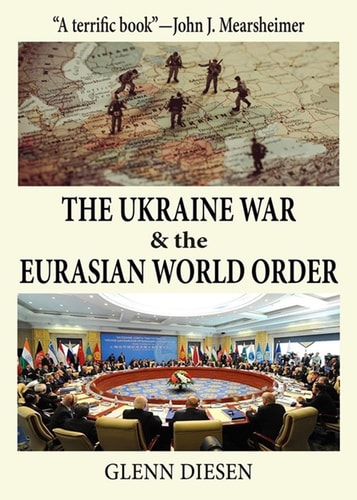
The Ukraine War & the Eurasian World Order
0
0
As an Amazon Associate and affiliate partner, Menrva Books earns from qualifying purchases. Learn more
Author Description
Five hundred years of Western hegemony has ended, while the global majority's aspiration for a world order based on multipolarity and sovereign equality is rising. This incisive book addresses the demise of liberal hegemony, though pointing out that a multipolar Westphalian world order has not yet taken shape, leaving the world in a period of interregnum. A legal vacuum has emerged, in which the conflicting sides are competing to define the future order. NATO expansionism was an important component of liberal hegemony as it was intended to cement the collective hegemony of the West as the foundation for a liberal democratic peace. Instead, it dismantled the pan-European security architecture and set Europe on the path to war without the possibility of a course correction. Ukraine as a divided country in a divided Europe has been a crucial pawn in the great power competition between NATO and Russia for the past three decades. The war in Ukraine is a symptom of the collapsing world order. The war revealed the dysfunction of liberal hegemony in terms of both power and legitimacy, and it sparked a proxy war between the West and Russia instead of ensuring peace, the source of its legitimacy. The proxy war, unprecedented sanctions, and efforts to isolate Russia in the wider world contributed to the demise of liberal hegemony as opposed to its revival. Much of the world responded to the war by intensifying their transition to a Eurasian world order that rejects hegemony and liberal universalism. The economic architecture is being reorganised as the world diversifies away from excessive reliance on Western technologies, industries, transportation corridors, banks, payment systems, insurance systems, and currencies. Universalism based on Western values is replaced by civilisational distinctiveness, sovereign inequality is swapped with sovereign equality, socialising inferiors is replaced by negotiations, and the rules-based inte
Menrva's Summary
THE THESIS
The book investigates the collapse of Western hegemony and the emergence of a multipolar world order following the war in Ukraine. The author, Glenn Diesen, argues that the post-war international system is in a period of interregnum, characterized by a legal vacuum where competing powers vie to define the future global order. Diesen posits that NATO expansionism, intended to secure Western dominance, instead dismantled European security and precipitated the current conflict. The war in Ukraine, therefore, is presented not as an isolated event, but as a symptom of this broader systemic collapse, revealing the illegitimacy and dysfunction of liberal hegemony.
THE SCOPE MAP
- Analysis of the historical trajectory of Western hegemony over five centuries.
- Examination of the rise of multipolarity and the aspiration for sovereign equality among the global majority.
- Critique of NATO expansionism and its role in dismantling the pan-European security architecture.
- The war in Ukraine as a symptom and catalyst for the collapse of the existing world order.
- Exploration of the legal vacuum and competing definitions of the future global order.
- The impact of sanctions and Russia's isolation on the demise of liberal hegemony.
- The ongoing reorganization of the global economic architecture away from Western reliance.
- The shift from universalism based on Western values to civilizational distinctiveness and sovereign equality.
THE AUTHORITY PERSPECTIVE
The book analyzes the geopolitical shifts occurring as Western hegemony wanes and a multipolar world order emerges, with the war in Ukraine serving as a critical inflection point. It posits that the current international system is in a transitional phase, marked by a struggle to establish new norms and power structures. The author's perspective highlights the unintended consequences of NATO expansion and critiques the legitimacy and efficacy of liberal internationalism in the face of rising Eurasian influence. The work suggests a fundamental reordering of global economic and political frameworks is underway, moving away from Western dominance towards a system prioritizing sovereign equality and civilizational distinctiveness.
Page Count:
324
Publication Date:
2024-01-01
Publisher:
Clarity Press, Incorporated
ISBN-10:
1949762955
ISBN-13:
9781949762952
History
Politics
Non-Fiction
International relations
Geopolitics
Community Tags
Similar Books