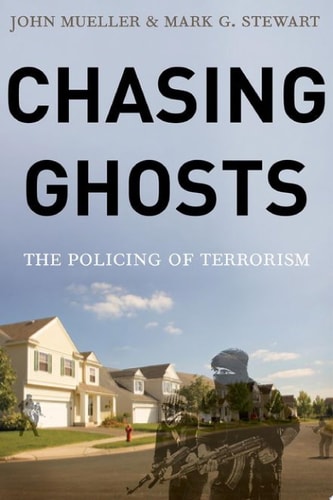
Chasing Ghosts
0
0
As an Amazon Associate and affiliate partner, Menrva Books earns from qualifying purchases. Learn more
Author Description
Since 2001, The United States Has Created Or Reorganized More Than Two Counterterrorism Organizations For Every Apprehension It Has Made Of Islamists Apparently Planning To Commit Terrorism Within The Country. Central To This Massive Enterprise Is What The Fbi Frequently Calls Ghost-chasing-the Efforts By Police And Intelligence Agencies To Follow Up On Over Ten Million Tips. Less Than One Alarm In 10,000 Fails To Be False-the Rest All Point To Ghosts. And The Vast Majority Of The Leads Deemed To Be Productive Have Led To Terrorist Enterprises That Are Either Trivial Or At Most Aspirational. As John Mueller And Mark G. Stewart Suggest In Chasing Ghosts, It Is Often An Exercise In Dueling Delusions: An Extremist Has Delusions About Changing The World By Blowing Something Up, And The Authorities Have Delusions That He Might Actually Be Able To Overcome His Patent Inadequacies To Do So. Chasing Ghosts Systematically Examines This Expensive, Exhausting, Bewildering, Chaotic, And Paranoia-inducing Process. It Evaluates The Counterterrorism Efforts Of The Fbi, The National Security Agency, The Department Of Homeland Security, And Local Policing Agencies. In Addition, It Draws From A Rich Set Of Case Studies To Appraise The Capacities Of The Terrorist Adversary And To Scrutinize The Myth Of The Mastermind. Mueller And Stewart Also Look Closely At Public Opinion, A Key Driving Force In Counterterrorism Efforts. The Chance That An American Will Be Killed By A Terrorist Within The Country Is About One In Four Million Per Year Under Present Conditions. However, Poll Data Suggest That, Although Over A Trillion Dollars Has Been Spent On Domestic Counterterrorism Since 2001, Americans Say They Do Not Feel Safer. No Defense Of Civil Liberties Is Likely To Be Effective As Long As People And Officials Continue To Believe That The Threat From Terrorism Is Massive, Even Existential. The Book Does Not Argue That There Is Nothing For The Ghost-chasers To Find-the Terrorist Adversary Is
Menrva's Summary
THE THESIS
This book investigates the efficacy and societal impact of the massive domestic counterterrorism apparatus established by the United States since 2001. John Mueller, a political scientist, and Mark G. Stewart, an expert in risk assessment, utilize extensive data on government spending, threat analysis, and public opinion to argue that current counterterrorism strategies are largely disproportionate to the actual threat level. They posit that the system is driven by a cycle of mutual delusion between ineffective extremists and an over-reactive security state, resulting in significant economic costs and the erosion of civil liberties.
THE SCOPE MAP
What You Will Find
- Analysis of FBI, NSA, and Department of Homeland Security counterterrorism operations.
- Quantitative assessment of domestic terrorism threats versus actual risk levels.
- Examination of the 'myth of the mastermind' through detailed case studies of apprehended individuals.
- Evaluation of public opinion data regarding perceived safety and government spending.
Scope Limits
- The text does not provide a comprehensive history of international terrorism outside of the domestic US context.
- It does not offer a detailed tactical manual for intelligence gathering or law enforcement procedures.
THE AUTHORITY PERSPECTIVE
Experts and reviewers frequently cite this work as a critical, data-driven challenge to the prevailing post-9/11 security consensus. Readers often note the academic density of the prose, which provides a rigorous, evidence-based critique of government policy and public perception.
Page Count:
240
Publication Date:
2015-01-01
Publisher:
Oxford University Press
ISBN-10:
0190237325
ISBN-13:
9780190237325
National security
Sociology
Public Policy
Counterterrorism
Community Tags
Similar Books