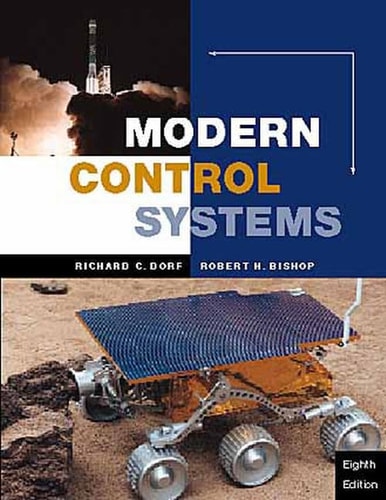
Modern Control Systems
0
0
As an Amazon Associate and affiliate partner, Menrva Books earns from qualifying purchases. Learn more
Author Description
Two new features have been added to the eighth edition to complement the book's strong integration of design and analysis. The Sequential Design Problem feature, using a disk drive as the example, highlights the main themes in each chapter and how they impact the design of a control system. A Continuous Design Problem is included at the end of each problem set to give students an opportunity to model, analyze, and design various types of controllers for a table-top machine tool as they proceed through the chapters. The textbook provides a clear exposition of the basic principles of control system design techniques using frequency- and time-domain methods as well as the state variable method.
Menrva's Summary
THE THESIS
This text investigates the fundamental principles and practical methodologies required for the design and analysis of modern control systems. Richard C. Dorf and Robert H. Bishop leverage their extensive academic and professional backgrounds to present a comprehensive framework that bridges theoretical control theory with real-world engineering applications. The authors utilize a structured pedagogical approach, incorporating both frequency-domain and time-domain analysis alongside state variable methods to equip students with the necessary tools for complex system modeling.
THE SCOPE MAP
What You Will Find
- Comprehensive coverage of frequency-domain and time-domain design techniques.
- Detailed exploration of the state variable method for system analysis.
- Sequential Design Problem features utilizing disk drive systems as practical case studies.
- Continuous Design Problem sets focused on modeling and controller design for machine tools.
THE AUTHORITY PERSPECTIVE
Experts and educators frequently identify this text as a foundational resource for undergraduate and graduate engineering curricula. Readers often note the academic density of the prose, which is balanced by the inclusion of rigorous problem sets and practical design examples.
Page Count:
855
Publication Date:
1998-01-01
Publisher:
Addison-Wesley
ISBN-10:
0201308649
ISBN-13:
9780201308648
textbook
Control systems
Technology
Engineering
Mathematics
Community Tags
Other Editions(11)






Similar Books








Reader Comments
Share Your Thoughts
No comments yet. Be the first to share your thoughts!