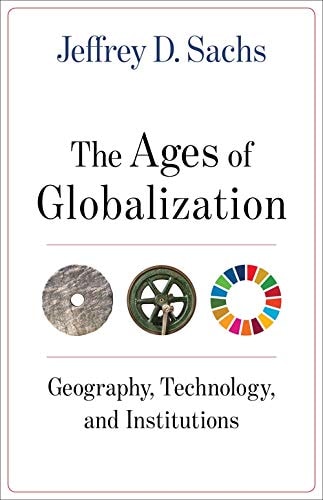
The Ages of Globalization: Geography, Technology, and Institutions
0
0
As an Amazon Associate and affiliate partner, Menrva Books earns from qualifying purchases. Learn more
Author Description
Today's most urgent problems are fundamentally global. They require nothing less than concerted, planetwide action if we are to secure a long-term future. But humanity's story has always been on a global scale. In this book, Jeffrey D. Sachs, renowned economist and expert on sustainable development, turns to world history to shed light on how we can meet the challenges and opportunities of the twenty-first century. Sachs takes readers through a series of seven distinct waves of technological and institutional change, starting with the original settling of the planet by early modern humans through long-distance migration and ending with reflections on today's globalization. Along the way, he considers how the interplay of geography, technology, and institutions influenced the Neolithic revolution; the role of the horse in the emergence of empires; the spread of large land-based empires in the classical age; the rise of global empires after the opening of sea routes from Europe to Asia and the Americas; and the industrial age. The dynamics of these past waves, Sachs demonstrates, offer fresh perspective on the ongoing processes taking place in our own time--a globalization based on digital technologies. Sachs emphasizes the need for new methods of international governance and cooperation to prevent conflicts and to achieve economic, social, and environmental objectives aligned with sustainable development. The Ages of Globalization is a vital book for all readers aiming to make sense of our rapidly changing world.
Menrva's Summary
THE THESIS
Today's most urgent problems are fundamentally global and require concerted, planetwide action for a secure future. Jeffrey D. Sachs, a renowned economist, uses world history to illuminate how humanity can meet the challenges of the twenty-first century. He examines seven waves of technological and institutional change, from early human migration to contemporary globalization driven by digital technologies. Sachs analyzes the interplay of geography, technology, and institutions across various historical periods, including the Neolithic revolution, the rise of empires, and the Industrial Age, to offer perspectives on current global dynamics.
THE SCOPE MAP
- Seven distinct waves of technological and institutional change throughout human history.
- Analysis of the interplay between geography, technology, and institutions in shaping historical developments.
- Examination of key historical periods: Neolithic revolution, emergence of empires, classical age, age of exploration, industrial age, and digital globalization.
- Insights into the dynamics of past globalization waves and their relevance to the present.
- Emphasis on the need for new international governance and cooperation for sustainable development.
THE AUTHORITY PERSPECTIVE
The book is presented as a vital resource for understanding our rapidly changing world, drawing on historical patterns to inform contemporary global challenges. Sachs's historical sweep and focus on the interconnectedness of geography, technology, and institutions aim to provide a framework for addressing twenty-first-century issues. The work emphasizes the necessity of new approaches to international governance and cooperation to achieve sustainable development objectives. It is positioned as a significant contribution for readers seeking to make sense of globalization.
Page Count:
262
Publication Date:
2020-01-01
Publisher:
Columbia University Press
ISBN-10:
0231193742
ISBN-13:
9780231193740
History
Non-Fiction
Economics
institutions
Technology
Globalization
Community Tags
Similar Books