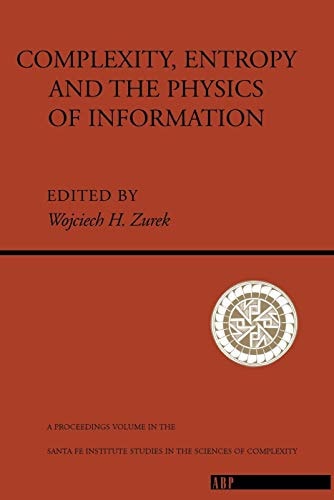
Complexity, Entropy and the Physics of Information
0
0
As an Amazon Associate and affiliate partner, Menrva Books earns from qualifying purchases. Learn more
Author Description
This book has emerged from a meeting held during the week of May 29 to June 2, 1989, at St. John’s College in Santa Fe under the auspices of the Santa Fe Institute. The (approximately 40) official participants as well as equally numerous “groupies” were enticed to Santa Fe by the above “manifesto.” The book―like the “Complexity, Entropy and the Physics of Information” meeting explores not only the connections between quantum and classical physics, information and its transfer, computation, and their significance for the formulation of physical theories, but it also considers the origins and evolution of the information-processing entities, their complexity, and the manner in which they analyze their perceptions to form models of the Universe. As a result, the contributions can be divided into distinct sections only with some difficulty. Indeed, I regard this degree of overlapping as a measure of the success of the meeting. It signifies consensus about the important questions and on the anticipated answers: they presumably lie somewhere in the “border territory,” where information, physics, complexity, quantum, and computation all meet.
Menrva's Summary
THE THESIS
This volume investigates the fundamental intersection of information theory, thermodynamics, and quantum mechanics to determine how these fields inform our understanding of physical reality. Edited by physicist Wojciech H. Zurek, the text compiles contributions from a 1989 Santa Fe Institute workshop, presenting a multidisciplinary framework that links the physical nature of information transfer with the evolution of complex systems. The authors argue that the boundaries between computation, entropy, and physical law are increasingly porous, requiring a unified approach to model the universe.
THE SCOPE MAP
What You Will Find
- Analysis of the relationship between quantum states and classical information processing.
- Theoretical explorations of entropy as a measure of physical complexity.
- Case studies on the evolution of information-processing entities and their model-building capabilities.
- Methodological discussions on the integration of computation into the formulation of physical theories.
THE AUTHORITY PERSPECTIVE
Experts recognize this collection as a foundational text for those interested in the early development of information physics. Readers frequently note the academic density of the prose, which requires a strong background in theoretical physics to fully grasp the technical arguments presented.
Page Count:
544
Publication Date:
1990-01-22
Publisher:
CRC Press
ISBN-10:
0201515067
ISBN-13:
9780201515060
Science
Physics
Computational complexity
Information Theory
Entropy
Complexity Theory
Community Tags
Other Editions(4)

Similar Books