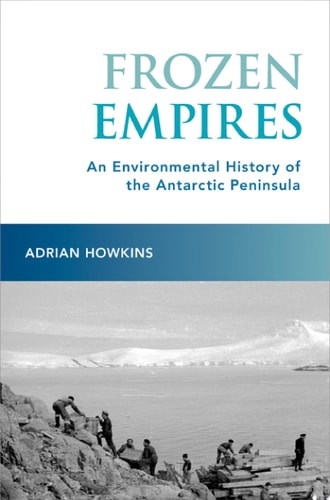
Frozen Empires
0
0
As an Amazon Associate and affiliate partner, Menrva Books earns from qualifying purchases. Learn more
Author Description
Perpetually covered in ice and snow, the mountainous Antarctic Peninsula stretches southward towards the South Pole where it merges with the largest and coldest mass of ice anywhere on the planet. Yet far from being an otherworldly pole apart, the region has the most contested political history of any part of the Antarctic continent. Since the start of the twentieth century, Argentina, Britain, and Chile have made overlapping sovereignty claims, while the United States and Russia have reserved rights to the entire continent. The environment has been at the heart of these disputes over sovereignty, placing the Antarctic Peninsula at a fascinating intersection between diplomatic history and environmental history. In Frozen Empires, Adrian Howkins argues that there has been a fundamental continuity in the ways in which imperial powers have used the environment to support their political claims in the Antarctic Peninsula region. British officials argued that the production of useful scientific knowledge about the Antarctic helped to justify British ownership. Argentina and Chile made the case that the Antarctic Peninsula belonged to them as a result of geographical proximity, geological continuity, and a general sense of connection. Despite various challenges and claims, however, there has never been a genuine decolonization of the Antarctic Peninsula region. Instead, imperial assertions that respective entities were conducting science for the good of humanity were reformulated through the terms of the 1959 Antarctic Treaty, and Antarctica's frozen empires remain in place to this day. In arguing for imperial continuity in the region, Howkins counters the official historical narrative of Antarctica, which rests on a dichotomy between bad sovereignty claims and good scientific research. Frozen Empires instead suggests that science, politics, and the environment have been inextricably connected throughout the history of the Antarctic Peninsula region--and remain so.
Menrva's Summary
THE THESIS
Howkins investigates the persistent intersection of environmental management and imperial sovereignty claims within the Antarctic Peninsula. The author, a historian specializing in polar regions, utilizes archival records and diplomatic history to challenge the conventional narrative that separates scientific research from political ambition. He argues that imperial powers have consistently leveraged environmental claims to maintain influence, effectively preventing genuine decolonization in the region.
THE SCOPE MAP
What You Will Find
- Analysis of overlapping sovereignty claims by Argentina, Britain, and Chile.
- Examination of the role of scientific knowledge as a tool for territorial justification.
- Historical assessment of the 1959 Antarctic Treaty and its impact on imperial continuity.
Scope Limits
- The text focuses primarily on the Antarctic Peninsula rather than the entire continent.
- It does not provide a comprehensive biography of individual explorers or scientists.
THE AUTHORITY PERSPECTIVE
Scholars in the field of environmental history recognize this work as a significant critique of the traditional dichotomy between political sovereignty and scientific inquiry. Readers often note the academic rigor of the research and the clarity with which the author connects historical diplomatic maneuvers to modern geopolitical realities.
Page Count:
320
Publication Date:
2016-01-01
Publisher:
Oxford University Press
ISBN-10:
0190249153
ISBN-13:
9780190249151
History
Geopolitics
Environmental History
Antarctica
International relations
Community Tags
Similar Books