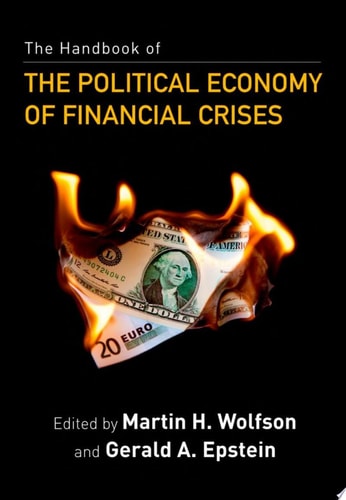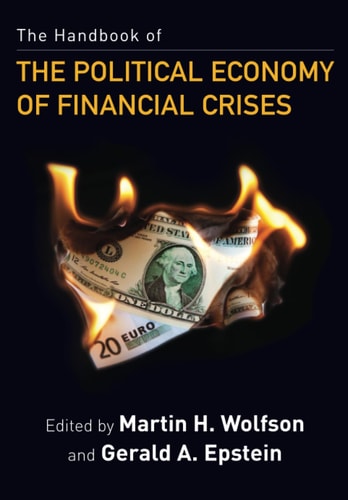
The Handbook of the Political Economy of Financial Crises
0
0
As an Amazon Associate and affiliate partner, Menrva Books earns from qualifying purchases. Learn more
Author Description
The Great Financial Crisis that began in 2007 reminds us with devastating force that financial instability and crises are endemic to capitalist economies, and that it is only strong and dynamically-changing financial regulations that can keep the damage caused by these crises within bounds. The international financial system and individual national economies, including that of the United States, are suffering from the aftermath of the worst financial crisis since the Great Depression. Economists are struggling to understand the origins and implications of the crisis. The Handbook of the Political Economy of Financial Crises uses a political economy theoretical framework to analyze the crisis.After an opening chapter that describes the dimensions of the current crisis, the next section provides relevant theoretical frameworks. Subsequent sections apply these theoretical frameworks to analyze the background, dimensions, and implications of the crisis for the world economy. Leading scholars push forward our understanding of how and why our international and domestic economies are susceptible to financial breakdown and what can be done to mitigate this problem in the future.The methodology throughout applies theoretical concepts in the context of an historical and institutional understanding of the real world. By emphasizing the historical and institutional aspects of financial crises, the authors advance economic knowledge and provide insights into how we can manage our financial system to improve the lives of ordinary people.
Menrva's Summary
THE THESIS
This volume investigates the structural causes and systemic implications of financial crises within capitalist economies, arguing that instability is an inherent feature of these systems. Editors Gerald A. Epstein and Martin H. Wolfson assemble a collection of scholarly contributions that utilize political economy frameworks to move beyond traditional neoclassical models. By integrating historical and institutional analysis, the authors provide a comprehensive evaluation of why international and domestic financial systems remain susceptible to recurring breakdown.
THE SCOPE MAP
What You Will Find
- Theoretical frameworks for analyzing financial instability
- Historical and institutional analysis of the 2007 financial crisis
- Comparative studies of international and domestic economic systems
- Policy recommendations for financial regulation and mitigation
Scope Limits
- Does not focus on micro-level personal finance or individual investment strategies
- Does not provide a purely mathematical or quantitative modeling approach to market fluctuations
THE AUTHORITY PERSPECTIVE
Experts recognize this handbook as a significant contribution to the field of heterodox economics, providing a robust alternative to mainstream financial analysis. Readers frequently note the academic density of the prose, which makes it a valuable resource for researchers and students interested in the intersection of politics and global finance.
Page Count:
786
Publication Date:
2015-07-01
Publisher:
Oxford University Press
ISBN-10:
0190240938
ISBN-13:
9780190240936
Economics
United States
Finance
Macroeconomics
Economic History