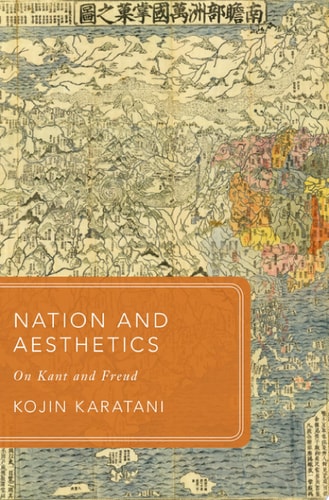
Nation and Aesthetics: On Kant and Freud
0
0
As an Amazon Associate and affiliate partner, Menrva Books earns from qualifying purchases. Learn more
Author Description
Nation and Aesthetics is a unique attempt to examine the ambiguous nature of nationalism and nation by examining them through aesthetics. In this translation by Jonathan E. Abel, Darwin H. Tsen, and Hiroki Yoshikuni, Karatani grasps the modern social formation as a nexus of three different "modes of exchange", namely capital-nation-state. Nation here plays the role of complementing capitalism and the state. Benedict Anderson defined nation as an "imagined community". Through rethinking Kant, Karatani suggests that "imagination" here is not a mere fancy, but very real, in the sense that it mediates state and capital. Usually imagination is regarded as fancying what is not present here. Kant grasped imagination as a faculty to imagine what we can understand but cannot sense; that is, to say, a faculty to mediate reason and sensibility. This observation provided the foundation to Modern aesthetics, which in the course of time became an important source of nationalism. In Italy, Germany, and Japan, nationalism appeared as fascism. They found in aesthetics a moment to go beyond capitalism and the state. The key to go beyond nation, Karatani argues, lies also in the thoughts of Kant, a cosmopolitan and an advocate of a world republic. It is well-known that the League of Nations was formed after First World War under the influence of his "Perpetual Peace". Karatani draws attention to the overlooked fact that around the same time Freud made a radical revision of his notion of the "superego". Karatani introduces article nine of Japan's postwar constitution, which renounces the right to wage war, as a crystallization of Kant's ideal of peace and Freud's superego. By providing a unique explanation of, and ways to counter, current nationalistic and imperialistic tendencies, Nation and Aesthetics argues that theories of Kant and Freud, which are usually understood to contrast, are deeply linked and suggest ways to go beyond capital-nation-state.
Menrva's Summary
THE THESIS
This work investigates the structural relationship between nationalism, aesthetics, and the modern social formation known as the capital-nation-state. Kojin Karatani, a prominent Japanese philosopher and critic, utilizes a rigorous theoretical framework to synthesize the works of Immanuel Kant and Sigmund Freud. By re-examining Kantian aesthetics and Freudian psychoanalysis, the author argues that these fields are not merely abstract concepts but are foundational to the mechanisms that sustain modern national identity and imperialistic tendencies.
THE SCOPE MAP
What You Will Find
- A tripartite analysis of the capital-nation-state nexus.
- A reinterpretation of Kantian imagination as a mediator between reason and sensibility.
- A comparative study of Freud's revised notion of the superego alongside Kant's political philosophy.
- An application of these theories to Japan's postwar constitution, specifically Article Nine.
Scope Limits
- The text does not provide a comprehensive history of global nationalism.
- It does not offer a practical political manual for contemporary governance.
THE AUTHORITY PERSPECTIVE
Scholars and readers frequently note the high level of academic density and the complex, interdisciplinary nature of Karatani's prose. Experts highlight this text as a significant contribution to political philosophy, particularly for those interested in the intersection of continental philosophy and modern social structures.
Page Count:
208
Publication Date:
2017-01-01
Publisher:
Oxford University Press
ISBN-10:
0190622989
ISBN-13:
9780190622985
Philosophy
Nationalism
Critical Theory
English & College Success
English
Aesthetics
Sociology
Eastern
Community Tags
Similar Books