
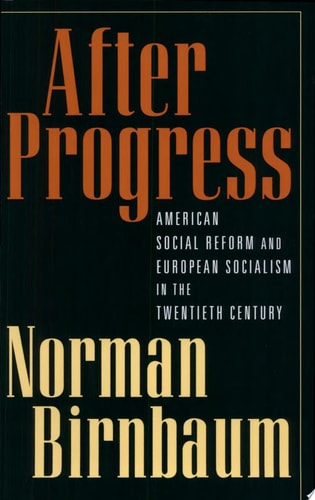
After Progress: American Social Reform and European Socialism in the Twentieth Century
0
0
As an Amazon Associate and affiliate partner, Menrva Books earns from qualifying purchases. Learn more
Author Description
The twentieth century witnessed a profound shift in both socialism and social reform. In the early 1900s, social reform seemed to offer a veritable religion of redemption, but by the century's end, while socialism remained a vibrant force in European society, a culture of extreme individualism and consumption all but squeezed the welfare state out of existence. Documenting this historic change, After Progress: European Socialism and American Social Reform in the 20th Century is the first truly comprehensive look at the course of social reform and Western politics after Communism, brilliantly explained by a major social thinker of our time. Norman Birnbaum traces in fascinating detail the forces that have shifted social concern over the course of a century, from the devastation of two world wars, to the post-war golden age of economic growth and democracy, to the ever-increasing dominance of the market. He makes sense of the historical trends that have created a climate in which politicians proclaim the arrival of a new historical epoch but rarely offer solutions to social problems that get beyond cost-benefit analyses. Birnbaum goes one step further and proposes a strategy for bringing the market back into balance with the social needs of the people. He advocates a reconsideration of the notion of work, urges that market forces be brought under political control, and stresses the need for education that teaches the rights and responsibilities of citizenship. Both a sweeping historical survey and a sharp-edged commentary on current political posturing, After Progress examines the state of social reform past, present and future.
Menrva's Summary
THE THESIS
This work investigates the historical divergence between American social reform and European socialism throughout the twentieth century to determine how market dominance eclipsed the welfare state. Norman Birnbaum, a prominent social theorist, utilizes a historical framework to analyze the transition from early twentieth-century reformist ideals to the contemporary culture of individualism. He argues that the current political climate prioritizes cost-benefit analysis over substantive social solutions, necessitating a re-evaluation of the relationship between market forces and democratic citizenship.
THE SCOPE MAP
What You Will Find
- A comparative analysis of European socialist development versus American social reform trajectories.
- Historical documentation of the impact of two world wars on Western political structures.
- An examination of the post-war golden age of economic growth and its subsequent decline.
- Proposed strategies for rebalancing market influence with social welfare and civic education.
THE AUTHORITY PERSPECTIVE
Scholars and political analysts recognize this text as a significant contribution to the study of twentieth-century political economy. Readers frequently note the dense, analytical nature of Birnbaum's prose, which serves as a foundational critique for those interested in the history of the welfare state.
Page Count:
448
Publication Date:
2001-01-01
Publisher:
Oxford University Press
ISBN-10:
0198028180
ISBN-13:
9780198028185
Economics
History
Socialism
Modern History
Sociology
Public Policy
Social Science
United States
Community Tags
Other Editions(2)
Similar Books