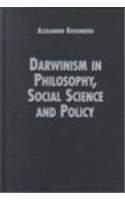
Darwinism in Philosophy, Social Science and Policy
0
0
As an Amazon Associate and affiliate partner, Menrva Books earns from qualifying purchases. Learn more
Author Description
How much can Darwinian mechanisms account for human values, the character of social institutions and the justification of our claims to knowledge in the sciences? Alexander Rosenberg, explores these questions and their ramifications in this collection of papers. The book will be of interest to students and professionals in the philosophy of science and the application of evolutionary biology to social science and policy.--Jacket.
Menrva's Summary
THE THESIS
The book investigates the extent to which Darwinian principles can explain human values, social structures, and the foundations of scientific knowledge. Alexander Rosenberg, a noted philosopher of science, examines these profound questions through a collection of essays. He draws upon evolutionary biology to analyze the origins and justifications of human morality, the formation of societal institutions, and the epistemological underpinnings of scientific inquiry. The work is intended for an audience engaged with the philosophy of science and the interdisciplinary application of evolutionary theory to social and policy matters.
THE SCOPE MAP
- Exploration of Darwinian mechanisms' capacity to account for human values.
- Analysis of how evolutionary biology informs the character of social institutions.
- Examination of the justification for knowledge claims within the sciences through an evolutionary lens.
- Discussion of the ramifications of applying evolutionary theory to social science and policy.
- Collection of papers by Alexander Rosenberg, a prominent figure in the philosophy of science.
- Target audience includes students and professionals in philosophy of science and evolutionary social science.
THE AUTHORITY PERSPECTIVE
The book is positioned as a significant contribution to the intersection of evolutionary biology, philosophy of science, and social theory. Its collection of papers by Alexander Rosenberg is expected to stimulate debate among academics and students interested in how evolutionary principles can illuminate human behavior, societal structures, and the nature of scientific knowledge. The work aims to bridge disciplines, offering a framework for understanding complex human phenomena through a Darwinian perspective. The intended audience is clearly defined as those engaged with advanced philosophical and scientific concepts.
Page Count:
257
Publication Date:
2000-01-01
ISBN-10:
0521662974
ISBN-13:
9780521662970
Science
Philosophy
Non-Fiction
Social Science
Public Policy
Evolutionary Biology
Community Tags
Similar Books