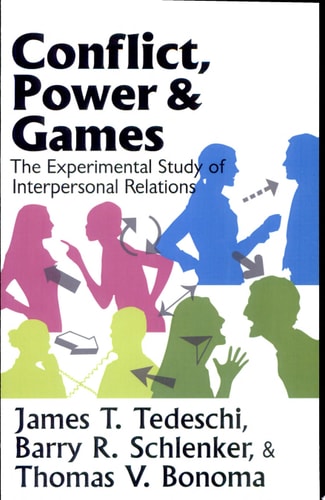
Conflict, Power, and Games: The Experimental Study of Interpersonal Relations
0
0
As an Amazon Associate and affiliate partner, Menrva Books earns from qualifying purchases. Learn more
Author Description
The technological revolution in the social sciences made available a set of research tools and data manipulation techniques that permit the study of complex social processes previously inaccessible or not amenable to our observational powers. One important set of tools took the generic title "experimental games," which were characterized by the interactive protagonists' pursuit of relatively well-defined goals whose achievement is dependent on the behavior of others. James T. Tedeschi, Barry R. Schlenker, and Thomas V. Bonoma, in this work, explicate these highly structured interactions.The grand strategy of scientific inquiry is the development of explanatory systems for natural phenomena. The empirical tactics devised to manipulate, control, observe, and measure events or processes of interest often require as much ingenuity and imagination as theory development itself. Generally the situation is so structured that certain rules govern participant behavior. Within these constraints the social psychological processes of conflict, influence, power, bargaining, and coalition formation can be studied. Concerned with the more formal and technical aspects of games, the authors explain how they are used for purposes of developing and testing scientific theory. The emphasis throughout is on the development and empirical evaluation of a scientific theory of social influence and power in situations where the interests of the interacting parties are in conflict.Experimental games have provided many of the concepts and the preponderance of evidence that have helped to unravel many of the complexities of social behavior. In "Conflict, Power, and Games", the authors build a bridge between technical and non-technical approaches in order to shed greater light on interpersonal relations.
Menrva's Summary
THE THESIS
How can experimental game theory be utilized as a rigorous methodological framework to analyze and quantify complex interpersonal dynamics such as power, influence, and conflict? The authors, led by James T. Tedeschi, leverage the technological advancements in social science research to move beyond observational studies toward controlled, empirical experimentation. By treating social interactions as structured games with defined goals and interdependent outcomes, the text provides a systematic approach to testing theories of human behavior within constrained environments.
THE SCOPE MAP
What You Will Find
- Methodologies for operationalizing social psychological processes like bargaining and coalition formation.
- Analysis of the structural constraints that govern participant behavior in interactive settings.
- Empirical data derived from experimental game simulations to validate theories of social influence.
- A bridge between formal technical modeling and broader non-technical applications in social psychology.
THE AUTHORITY PERSPECTIVE
Experts recognize this work as a foundational text for understanding the application of game theory to social psychological research. Readers frequently note the technical density of the prose, which serves as a specialized resource for students and researchers interested in the formal measurement of interpersonal conflict.
Page Count:
270
Publication Date:
1973-01-01
Publisher:
Aldine Pub. Co
ISBN-10:
0202250180
ISBN-13:
9780202250182
Sociology
Conflict Resolution
Behavioral Science
Game theory
Community Tags
Similar Books