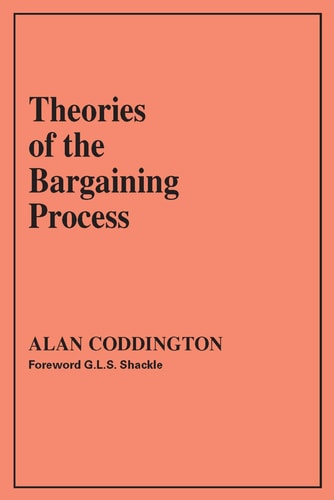
Theories of the Bargaining Process
0
0
As an Amazon Associate and affiliate partner, Menrva Books earns from qualifying purchases. Learn more
Author Description
A tour de force of theoretical reasoning, this book presents the most advanced analytical model of the bargaining process so far conceived. Focused essentially on the dynamics of the bargaining process, Coddington's model employs elements of several conceptual constructs--individual decision-making, theories of expectations and their adjustment, and environment concepts--to explain the nature of consistency in a bargainer's system of expectations and intentions.The book begins with a description of the bargaining process in an economic context and establishes an analytical framework. There follows a critical survey of bargaining theory in which the author selects those concepts, which he finds most valid and most applicable to his decision-making/expectation/adjustment model. The internal consistency of a wide class of bargaining models is then examined in a chapter on the relationship between decision-making and expectations. Since the theory of games has been used as a basis for bargaining process theory, the author devotes a chapter to an examination of the game-theoretic approach and an assessment of its value relative to his own approach.The author concludes with a study of the specific capabilities of his own analytical model, with discussion of the possible combinations of assumptions with which the investigator may work. Although stemming from a problem in economic theory and of immediate intent to economists, the book's contribution to the general theory of conflict process and interdependent decision-making make it an important study for students of politics and international affairs as well as management and labor relations specialists.
Menrva's Summary
THE THESIS
This book investigates the core question of how bargaining processes function through an advanced analytical model that integrates individual decision-making, expectation adjustment, and environmental variables. Alan Coddington, an economist, constructs a rigorous framework to explain the consistency of a bargainer's intentions. By synthesizing existing theories with his own model, he provides a systematic approach to understanding interdependent decision-making in economic and social contexts.
THE SCOPE MAP
What You Will Find
- An analytical framework for bargaining within economic contexts.
- A critical survey and evaluation of existing bargaining theories.
- A comparative assessment of game-theoretic approaches versus the author's decision-making model.
- Methodologies for examining the relationship between expectations and internal consistency.
THE AUTHORITY PERSPECTIVE
Experts recognize this work as a significant contribution to the formal study of conflict and negotiation. Readers frequently note the high level of theoretical density, making it a specialized resource for economists, political scientists, and labor relations professionals.
Page Count:
124
Publication Date:
2007-02-15
Publisher:
Routledge
ISBN-10:
0202309177
ISBN-13:
9780202309170
Economics
Game theory
Decision Theory
Management
Conflict Resolution
Monopolies
Community Tags
Other Editions(9)




Similar Books









Reader Comments
Share Your Thoughts
No comments yet. Be the first to share your thoughts!