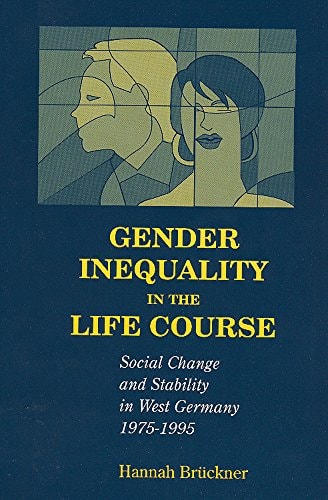
Gender Inequality in the Life Course: Social Change and Stability in West Germany, 1975-1995
0
0
As an Amazon Associate and affiliate partner, Menrva Books earns from qualifying purchases. Learn more
Author Description
How do women fare in a society that is characterized by a set of institutions that promote income stability over the life course and thereby maintain and even amplify status difference? Using recently issued public files of social security records with longitudinal earnings data of well over half a million persons, this book describes gender inequality in earnings and labor market participation in contemporary Germany between 1975 and 1995.Because of the advanced industrial base of Germany, its relevance to other nations at the high end of production and consumer indices becomes apparent. Brückner's work is a unique combination of empirical and theoretical work. She takes seriously the effect of marriage status on labor supply and wages: married men work more and earn more, while married women work less and earn less. But to this rather conventional measure she introduces a second important consideration: the life course, multiple social contexts that help explain the unfolding of social action and economic status. In this way the family becomes a critical factor in explaining such crucial sources of inequality as tax laws, property transference, and transfer payments--and how these are regulated by the welfare state. The results from a life course analysis are contrasted with cross-sectional trends and a traditional lifecycle model to show that much depends in part on the data and methods used to explore it. The work closes with a solid social scientific analysis of systems choices: the private market in contrast to the social democratic welfare state solution. While recognizing that the latter is a direct effort at resolving the gender gap in wages and welfare, Professor Brückner also appreciates that there are high costs to the overall economy, not the least being a taxation that erodes the earning power of families and individuals as a whole, and hence is less of a solution than the spreading of the problem.
Menrva's Summary
THE THESIS
This book investigates how institutional frameworks in West Germany between 1975 and 1995 influenced gender inequality in earnings and labor market participation over the life course. Hannah Brueckner, a scholar in social science, utilizes longitudinal earnings data from over half a million social security records to challenge traditional cross-sectional models of economic status. By integrating the life course perspective with an analysis of welfare state regulations, the author argues that family structures and state-level tax policies significantly dictate the economic outcomes of men and women differently.
THE SCOPE MAP
What You Will Find
- Longitudinal analysis of West German social security records spanning 1975 to 1995.
- Comparative evaluation of life course models versus traditional cross-sectional lifecycle models.
- Examination of the impact of marriage, tax laws, and welfare state regulations on labor supply.
- Theoretical assessment of private market solutions versus social democratic welfare state interventions.
THE AUTHORITY PERSPECTIVE
Experts recognize this work as a rigorous application of longitudinal data to the study of gendered economic disparities. Readers frequently note the academic density of the prose and the author's precise methodological approach to institutional analysis.
Page Count:
158
Publication Date:
2004-05-31
Publisher:
Routledge
ISBN-10:
0202306917
ISBN-13:
9780202306919
Economics
Sociology
Women
Social Conditions
Gender Studies
Social policy
Womens rights
Germany
Women germany
Labor Studies
Community Tags
Other Editions(2)
Similar Books







Reader Comments
Share Your Thoughts
No comments yet. Be the first to share your thoughts!