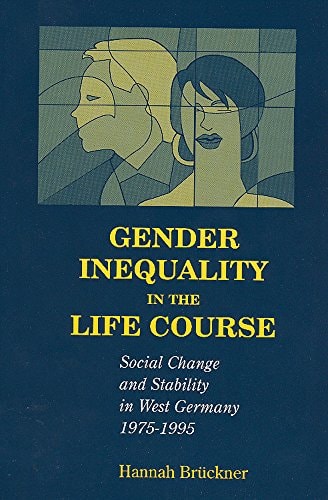
Gender Inequality in the Life Course: Social Change and Stability in West Germany, 1975-1995
0
0
As an Amazon Associate and affiliate partner, Menrva Books earns from qualifying purchases. Learn more
Author Description
How do women fare in a society that is characterized by a set of institutions that promote income stability over the life course and thereby maintain and even amplify status difference? Using recently issued public files of social security records with longitudinal earnings data of well over half a million persons, this book describes gender inequality in earnings and labor market participation in contemporary Germany between 1975 and 1995.Because of the advanced industrial base of Germany, its relevance to other nations at the high end of production and consumer indices becomes apparent. Brückner's work is a unique combination of empirical and theoretical work. She takes seriously the effect of marriage status on labor supply and wages: married men work more and earn more, while married women work less and earn less. But to this rather conventional measure she introduces a second important consideration: the life course, multiple social contexts that help explain the unfolding of social action and economic status. In this way the family becomes a critical factor in explaining such crucial sources of inequality as tax laws, property transference, and transfer payments--and how these are regulated by the welfare state. The results from a life course analysis are contrasted with cross-sectional trends and a traditional lifecycle model to show that much depends in part on the data and methods used to explore it. The work closes with a solid social scientific analysis of systems choices: the private market in contrast to the social democratic welfare state solution. While recognizing that the latter is a direct effort at the resolving the gender gap in wages and welfare, Professor Brückner also appreciates that there are high costs to the overall economy, not the least being a taxation that erodes the earning power of families and individuals as a whole, and hence is less of a solution than the spreading of the problem.
Menrva's Summary
THE THESIS
This book investigates how institutional frameworks in West Germany between 1975 and 1995 influenced gender inequality in earnings and labor market participation. Hannah Brueckner, a scholar in sociology and life course research, utilizes longitudinal social security records for over half a million individuals to analyze the intersection of family status, welfare state policies, and economic outcomes. By contrasting life course analysis with traditional lifecycle models, the author argues that institutional structures—specifically tax laws and transfer payments—significantly shape the economic trajectories of men and women differently.
THE SCOPE MAP
What You Will Find
- Longitudinal earnings data from over 500,000 social security records.
- Comparative analysis of cross-sectional trends versus life course modeling.
- Examination of the impact of marriage and family status on labor supply and wages.
- Evaluation of the welfare state versus private market systems in addressing the gender wage gap.
THE AUTHORITY PERSPECTIVE
Experts recognize this work as a rigorous application of life course methodology to German labor market data. Readers frequently note the academic density of the prose and the technical nature of the statistical analysis provided.
Page Count:
158
Publication Date:
2004-07-31
Publisher:
Routledge
ISBN-10:
0202306925
ISBN-13:
9780202306926
History
Economics
Womens rights
Gender Studies
Women germany
Sociology
Women
Labor Studies
Germany
Community Tags
Other Editions(2)
Similar Books










Reader Comments
Share Your Thoughts
No comments yet. Be the first to share your thoughts!