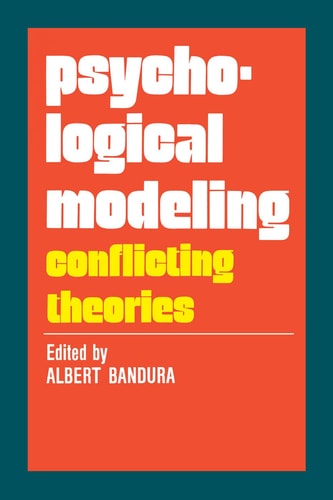
Psychological Modeling: Conflicting Theories
0
0
As an Amazon Associate and affiliate partner, Menrva Books earns from qualifying purchases. Learn more
Author Description
The phenomenon of learning has always been of fundamental interest to psychologists. Although much of the research in this area approaches the process of learning as a consequence of direct experience, this volume is principally concerned with learning by example.A widening interest in modeling and vicarious processes of learning has been apparent in recent years. Psychological Modeling highlights the most important work done in the subject and offers an extensive review of the major theories of learning by modeling. In his introductory essay, the editor identifies the most important controversial issues in the field of observational learning and reviews a large body of research findings.Among the questions debated in this volume are: How do observers form an internal model of the outside world to guide their actions? What role does reinforcement play in observational learning? What is the relative effectiveness of models presented in live action, in pictorial presentations, or through verbal description? What is the scope of modeling influences? What factors determine whether people will learn what they have observed? What types of people are most susceptible to modeling influences, and what types of models are most influential in modifying the behavior of others?This volume deals with an important problem area in a lively fashion. Its special organization makes it a stimulating adjunct to all courses in psychology - undergraduate and graduate - in which psychological modeling is discussed. It also provides a readable introduction for educators and other professionals seeking reliable information on the state of knowledge in this area.
Menrva's Summary
THE THESIS
This volume investigates the mechanisms of observational learning and the extent to which behavior is acquired through the observation of models rather than direct experience. Albert Bandura, a seminal figure in social cognitive theory, compiles and critiques existing research to address how internal representations of the world guide human action. The text provides a structured examination of the variables that influence the efficacy of modeling, including the nature of the model and the characteristics of the observer. By synthesizing diverse experimental findings, the work establishes a framework for understanding vicarious learning processes.
THE SCOPE MAP
What You Will Find
- Comparative analysis of live, pictorial, and verbal modeling techniques
- Examination of reinforcement roles in observational learning
- Review of factors determining observer susceptibility to modeling
- Synthesis of experimental data regarding internal cognitive modeling
THE AUTHORITY PERSPECTIVE
Experts recognize this volume as a foundational text for understanding the development of social learning theory. Readers frequently note the academic density of the prose, which serves as a comprehensive resource for both graduate students and professionals in the field of psychology.
Page Count:
218
Publication Date:
2006-07-15
Publisher:
Routledge
ISBN-10:
0202308480
ISBN-13:
9780202308487
Psychology
Cognitive Psychology
Learning Psychology of
Learning Theory
Academic
Behavioral Science
Community Tags
Other Editions(3)


Similar Books












Reader Comments
Share Your Thoughts
No comments yet. Be the first to share your thoughts!