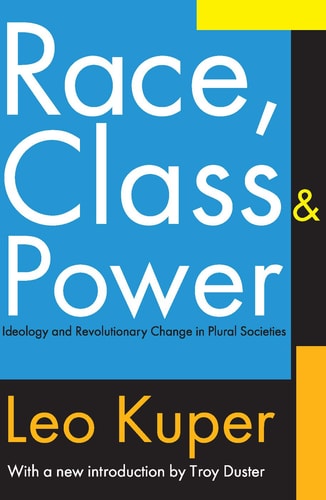
Race, Class, and Power: Ideology and Revolutionary Change in Plural Societies
0
0
As an Amazon Associate and affiliate partner, Menrva Books earns from qualifying purchases. Learn more
Author Description
Examining in detail the apparently inexorable polarization of society in such countries as Rwanda, Algeria, and South Africa, the author questions whether current theories correctly explain the past or offer adequate guides for the future. In their place he puts forward an alternative neo-Durkheimian view of the possibility of non-violent revolutionary change, based on the development of such social and cultural continuities as already exist within each plural society. But he warns that "this is an age of passionate commitment to violence in which vicarious killers abound in search of a Vietnam of their own." The aim of this groundbreaking and challenging book is to create theoretical perspectives in which to view the racial conflict of plural societies. Written in the turbulent early 1970s, the book demonstrates the inadequacy of then prevailing views such as Marxist interpretations of racial conflict as class struggle, and the Fanon a priori rejection of non-violent techniques of change, which Kuper holds responsible for the acceptance of what he calls "the platitudes of violence." The book concludes with more personal sections focusing on the author's struggles with the then prevailing South African society, critiques of that, and censorship of his attempts to make these public. In the light of subsequent changes in South Africa many decades later, this book serves not only as an important work of political sociology but as a personal testament to the fight against racism in South Africa. Leo Kuper was professor of sociology and director of the African Studies Center at the University of California, Los Angeles. A South African by birth, he was one of the first writers on genocide as well as other aspects of African studies and urban sociology. His major book, Genocide (Penguin, 1981), remains in print. The Leo Kuper Foundation is a non-governmental organization dedicated to the eradication of genocide through research, advice, and education. It was created in Wa
Menrva's Summary
THE THESIS
This work investigates whether existing sociological theories adequately explain the polarization and potential for revolutionary change within plural societies. Leo Kuper, a sociologist and expert in African studies, challenges prevailing Marxist and Fanonian interpretations of racial conflict. He proposes a neo-Durkheimian framework that emphasizes social and cultural continuities as a viable path for non-violent revolutionary transformation in nations such as South Africa, Rwanda, and Algeria.
THE SCOPE MAP
What You Will Find
- Comparative analysis of racial and class polarization in pluralistic societies.
- Critique of Marxist and Fanonian theories regarding violent versus non-violent change.
- Neo-Durkheimian theoretical framework for social integration.
- Personal reflections on censorship and political struggle in South Africa.
THE AUTHORITY PERSPECTIVE
Experts recognize this text as a significant contribution to political sociology and the study of racial conflict in the 20th century. Readers frequently note the academic density of the prose and the historical importance of Kuper's personal testimony regarding South African apartheid.
Page Count:
348
Publication Date:
2005-08-31
Publisher:
Routledge
ISBN-10:
0202308006
ISBN-13:
9780202308005
History
Social change
Revolutions
Power Social sciences
Sociology
Race Relations
Community Tags
Other Editions(2)
Similar Books




Reader Comments
Share Your Thoughts
No comments yet. Be the first to share your thoughts!